If you’re taking a road trip this holiday season, be prepared to meet plenty of fellow travelers on the highway. AAA is estimating a record 93.3 million American  drivers will be hitting the road for the holidays. That’s an increase of 1.6% over last year and just 400,000 people less than the biggest holiday travel year in 2006.
The high price of plane travel is blamed for the increase in driving this holiday season. The highest travel days will occur between December 22 and January 1, when 84.4 million Americans will take to the road. That means that roughly one-quarter of all Americans will be driving at least 50 miles during that time, making for crowded highways, rest stops, toll booths and off-ramp gas stations.
U.S. gas prices are at an average of $3.23 per gallon, which is roughly what drivers paid during last year’s holiday season. Although the price is relatively high, the fact that it’s come down over the last few months helps drivers justify driving long distances, versus going by plane. Prices are expected to range from $3.20 to $3.40 a gallon between Christmas and New Years.
AAA president and CEO Robert Darbelnet says, “The year-end holiday season remains the least volatile of all travel holidays as Americans will not let economic conditions or high gas prices dictate if they go home for the holidays or kick off the New Year with a vacation.”
The rise in Christmas and New Year’s driving follows an upsurge in road travel during Labor Day, when roads saw a 2.9% rise over last year. The Memorial Day and Labor Day holidays also saw driving increases of 1.2% and 4.9%, respectively.
AAA’s travel survey was performed by IHS Global Insight and is based on interviews with 655 people about their holiday travel plans.
Approximately 15 million people will avail themselves of the nation’s airlines between Dec. 17 and Jan. 6, a figure that’s up from 2011’s holiday air travel figure.
If you’d like to save as much as 30% on your auto insurance – and who wouldn’t? – a new program called usage-based insurance might just be your ticket to lowering your premiums.
Usage-based insurance (UBI) allows insurers to track how much customers drive via a small tracking device and adjust the insurance premium based on the information they receive. Allstate, Progressive and State Farm are among the U.S. insurance companies that have already instituted UBI programs, and the response from their customers has been overwhelmingly positive. Insurers in Europe and other countries are also joining the trend toward usage-based car insurance using onboard diagnostic devices.
Backing up the trend, a company called Strategy Meets Action recently released a statement predicting the rapid growth of UBI products. They project that half of all auto insurance policies will be usage-based by the year 2020, with one-fifth of all insurers offering usage-based products.
For people who use their vehicles infrequently, or whose vehicles spend days or even weeks at a time parked at airports the UBI trend can offer significant savings over time.
The tracking devices are connected to the vehicle via the onboard diagnostics system located at a port under the steering column. In addition to mileage data, they are also able to collect information about driving style, which can also be used to assess risk and instruct insurers as to how to structure customer premiums.
Progressive Insurance is one of the companies at the forefront of the UBI trend, having already installed more than a million telegenics devices in vehicles to calculate driver usage. A number of other companies have begun promoting their UBI programs to give discounts to drivers who spend less time behind the wheel. Ten large auto insurers have usage based premium programs, but they’re not widely promoted and are available in just a few states.
In addition to encouraging people to drive less, usage-based insurance will have the side-effect of lowering carbon emissions. That’s a win-win for drivers and for the environment.
Dear Mr. Claus,
Regarding the highly unusual nature of your recent claim for repairs to your vehicle in the amount of $124,568.27, GEICO has the following questions and concerns.
First off, you’ve listed your reindeer-powered vehicle in the ‘delivery utility’ category and stated that it’s used solely for business during one annual 24-hour period from dusk on December 24th, until sunrise on the 25th. You also stated that the mileage driven during that time is 150,365 miles (approximately). You also mention that during this period that you park on various “rooftops” which we can only assume to mean parking garages located at the roof level.

GEICO recognizes that your means of employment is highly unusual (as is your vehicle and driving style) and we’ve done our best to accommodate your insurance needs, however curious they may seem. In light of your recent accident, we’d like to point out the following:
- The claim that you drove 150,364 miles in a single night would suggest that you are traveling at speeds in excess of 6,265 miles per hour, which is not only questionable in accuracy, but would be highly illegal and instantly void your claim if this were indeed true. Please clarify.
- We are having difficulty locating your vehicle in our database, as you have listed the make as “Red Sleigh” and the engine type as “9 Reindeer-powered” which we can only assume you actually meant “9 horsepower.” If this is a new eco-friendly vehicle on the market, please let us know.
- Your qualification for coverage is also in question due to the fact you have not listed “Elves” as additional drivers on your policy, who became inebriated while using the company vehicles in an unlawful manner. Please provide names of these drivers as well as employment verification documentation.
- One eye-witness report said “Away they all flew like the down of a thistle” which would suggest to us that you may not even be eligible at all for our auto insurance, but rather our aircraft policy.
- On a side-note, you have also caused damage claims from homeowners who assert that you have caused damage to their roofs by animals; and last year you became stuck in a homeowners chimney. We are still investigating whether this is a trespassing, or break-and-entry case.
- In the police report, they also mentioned that you only had a single headlamp operational at the time of the incident.
Given the highly unusual nature of your business, we want to point out that our willingness to provide coverage stems from the fact that you run a non-profit business whose sole aim is to ‘bring joy to millions of children throughout the world’, for which you receive no financial consideration. That is certainly a worthy enterprise, however we can only stretch our limits of coverage so far when it comes to your unusual needs.
Specifically, your claim for repairs for the accident that occurred on the night of November 29th states that two inebriated ‘elf’ employees commandeered several reindeer and took the vehicle for a joyride without your permission, crashing it into a snowbank after shearing off the tops of several large fir trees. You state that the runners on your vehicle were bent beyond repair and need to be replaced, as do the “jingle bells” and steering mechanism (such vehicle modifications were not listed on your policy).
You also state that the antlers of two “reindeer” became entangled in the crash and require cosmetic reconstruction of $15,900 each to mend their disfigurement. We have been contacted by legal representatives for Prancer and Dancer, who are filing a claim for a considerable amount. In addition to the expense of cosmetic antler reconstruction, they’re filing a suit for pain and suffering due to the ridicule they’ve received from their fellow reindeer and elf co-workers, who are apparently quite cruel in their mockery. Perhaps you could mediate this situation with your employees.
Meanwhile, we are forthwith dispatching our North Pole claims representative, to your address at 100 Saint Nicholas Lane, Ho Ho Township, North Pole 00001 to inspect the vehicle. Please do not make any repairs until he arrives. As our attempts to locate your address on MapQuest and Google Earth have turned up nothing but a large iceberg populated with penguins and polar bears, please forward detailed directions to your location. As you may recall, last year one of our representatives was unable to find your address and spent several days in an abandoned igloo waiting for rescue. We hope to avoid a similar incident again.
We assume that the elves responsible for the damage have been terminated from your employment and suggest that for additional savings on your corporate policy, that you conduct regular drug and alcohol screenings for all of your employees. Please remember to keep your vehicle locked at all times so that it’s no longer accessible to unauthorized elfin drivers.
Due to these annually recurring reported claims, we will be increasing your ultra-short term insurance policy (one day a year) to $121,492.53. And while we have rejected similar claims every year in the past, we would like to remind you that you are still saving $140 over Esurance, and $95 over Statefarm.
P.S. Please fix your birth date as listed on the policy as it appears to have a large typographical error.
Regards,
Jane Newyear
GEICO Claims Representative
There are almost 200 million dogs and cats as pets in the United States, and of course those pets sometimes have to travel with us. They may be going  with us a mile down the road to the grocery store or 3,000 miles across country. Sometimes however people forget about the need for pet automotive safety and procedures.
How many times have you driven down the highway seeing a dog wagging his tongue out the window and thinking, “Ohh, that’s so cute!!!” never realizing how unsafe the situation is for the driver and the pet. Animals need proper restraints just like people do. There are many different kinds of pets people keep these days, but this will focus on cats and dogs and smaller animals. An animal can be thrown from a car in accident just as easily as a human, if not easier due to their smaller size. Even in situations where a car must stop short, an animal has no means to brace itself when not secure. Small dogs and cats, and other smaller mammals should be secured in pet carriers. There are pet carriers designed that can be attached to a seatbelt restraint system. For larger animals that cannot fit in a standard pet carrier there are seat belt extensions. An easy online search “seat belts for dogs” shows dozens of hits for dog harness restraint systems. This isn’t just a safety issue for the animal. An excited pet could wreak havoc on a driver. A nervous or excited pet could jump on any part of the driver’s body, causing them to lose control of the vehicle and possibly resulting in an accident.
Pets and vehicles aren’t just a concern when in motion, there are other issues related to pets in cars. Many people leave their pets when going to a store, a restaurant, or many other places that pets aren’t allowed. It isn’t just a climate control issue. Many pets are fearful of strangers, from a Chihuahua to a Pit Bull. Any dog bite can be serious, requiring stitches or shots. An unsecured dog waiting for its owner in a parking lot could see a passing pedestrian as a threat and attempt to attack that person. When climate is not an issue, and the animal is left in the car, they should still be secured in their harness or pet carrier. Anyone who has gotten into a car on a sunny day knows it’s much hotter and more difficult to breath than on the outside. A car parked in the sun even with the windows open slightly can go from 80 to over 100 degrees in a matter of minutes, with poor air quality in top of it. Even on relatively cooler days say at 70, the interior of a car can still reach close to 100 degrees when parked in the sun.
An easy rule of thumb is to treat your pets like people when traveling; of course I think they can be trusted when left alone in a car not to attach strangers. On a serious note though, secure pets appropriately, people are secured appropriately, realize heat is bad for pets as it is for people, in some cases even much worse.
Believe it or not there are some states that do not require you to have car insurance, although all states do have financial responsibility laws. There are  plenty of bad drivers out there who actually drive around with no insurance illegally. This is one of the reasons for uninsured motorist’s coverage, but there are plenty of drivers who don’t carry insurance and it’s legal.
As opposed to having insurance some states allow drivers to prove they can pay if responsible for an accident, meaning, prove financial responsibility. Proving financial responsibility is a pretty cumbersome task. To prove responsibility some states require the issuance of a surety bond. The absurdity of purchasing a bond as opposed to a typical insurance policy is that the bond can cost more! A bond can cost 4% or more of the liability amount that you are purchasing as a bond, so $35,000 limit, $1,400 cost, just for liability. Thus a bond is typically not more economically feasible than an insurance policy. Some states also allow large cash deposits as opposed to surety bonds or an insurance policy. Depositing as much as $50,000 with the applicable state to prove you can pay if in an at fault accident. This way your money is tied up at a low interest rate and untouchable.
Several states allow for proof of financial responsibility as opposed to carrying typical automobile insurance. Some notable states that allow for proof of financial responsibility as opposed to insurance are California, Ohio, Tennessee, Texas and Washington, each state still has their cumbersome financial responsibility requirements, such as bonds or deposits with the appropriate state’s treasurer. The most unique state for actually not having to carry any insurance is New Hampshire. As long as a driver’s record is clean, they do not have to carry insurance, or prove financial responsibility. However, once a certain number of points are on a driver’s record, or they are convicted of a driving while intoxicated charge, they are required to purchase a minimum liability limit. Next time you are in New Hampshire and you see a no helmet motorcycle rider, just think not only are they risking their lives they may not even have insurance, truly Live Free or Die, per the state motto.
Driving without insurance is a nonsensical gamble, with no high-risk high reward scenario, it’s all risk. An individual could lose all their assets if found at fault in a serious accident, with no insurance to protect them. Even if the accident appears to not be the uninsured driver’s fault, court costs alone to defend one’s self could be in the thousands. With several options and competitive markets for insurance, as well as affordable and convenient payment plans, there is no reason to not be insured. If you can afford to drive you can afford insurance.
A new study conducted by Toyota and the University of Michigan has found that when it comes to distracted driving, if your kids even “think” that you  are driving distracted they are likely to do the same when they get behind the wheel.
The studies authors also report that teens are under the impression that their parents are much worse drivers than they actually are. The study interviewed over 400 teen-parent pairs that were living in the same household to reach their conclusions.
In a recent press release Ray Bingham, a research professor with the study said, “Overall, teens think that their parents engage in distracted driving behaviors more often than may be the case, which may allow them to justify certain high-risk behaviors behind the wheel”
In a breakdown of distracted driving behaviors, the study found that teens believe their parents engage in the following behaviors:
- 32 percent – Use a music device while driving.
- 71 percent – Read or write down directions while driving.
- 85 percent – deal with passenger issues.
All of these percentages were higher than what parents actually reported. The study found that teens tend to engage in risky behavior based on their “beliefs” of what their parents are doing, not on the actual behavior their parents are modeling.
As an example, teens whose parents eat or drink while driving a car were 2.2 times more likely to do the same than teens with parents who did not eat or drink while driving; but teens who “think” their parents were snacking behind the wheel were 3.4 times more likely to engage in the same behavior. This pattern was repeated when other behaviors such as dealing with passengers and searching for items in the car were examined.
Teens were not the only ones misjudging behaviors. Only one percent of the parents were convinced their teen was reading or sending texts while driving but a whopping 26 percent of teens admitted to engaging in that behavior when behind the wheel.
A recent Students Against Destructive Decisions (SADD) study found many of the same results. Their study focused on connections between parents, teen drivers and distracted driving. It examined what teens actually saw their parents doing while driving and concluded that teens engage in bad habits behind the wheel that mirrored the rates of their parents.
The SADD study found that 91 percent of the teens surveyed reported seeing their parent talk on a phone while driving. When asked about their own driving habits, 90 percent of the teens admitted to talking on the phone while driving.
These studies will hopefully help parents and local governments convince teens that distracted driving is a dangerous behavior. Currently 39 states ban all drivers from texting while driving and 32 states ban new drivers from using a cellphone at all. Enforcement can be sporadic and these laws are often difficult to enforce.
The federal government is pushing to increase awareness of distracted driving issues as well as toughen graduated driver license laws to keep young inexperienced drivers off their phones when behind the wheel. New York recently made distracted driving a major law enforcement initiative, upping the penalty to 3 points on your license. In most cases 3 points on your license would affect insurance rates.
New released studies show that teens are affected not only by behaviors they see their parents engaging in but also behaviors that they “think” their parents engage in. Modeling good driving habits is key for any parent who wants to keep their teen safe during those dangerous first years behind the wheel.
By Aaron Crowe
Children aren’t the only ones who want Christmas presents. As an adult, you can still find joy in getting a gift from a loved one. The same goes for cars.
Getting a gift for your car is basically getting a gift for yourself, but it’s also a thank-you to your car for taking care of you all of these years. It has gotten you to work, taken you on dates, and helped you get errands done.
A study on outdoor advertising found that Americans spend an average of 15 hours per week in their cars. That’s a lot of time to not have the best gadgets for your car.
In the hope that Santa Claus might bring us something for our car after he gets his sleigh tricked out, here’s our Christmas wish list of the best presents for a car:
Keep the phone out of hand: A mount to keep an iPhone or Android phone out of your hands but near enough so you can talk on it is important so you won’t be distracted while driving. Josh Smith, editor at GottaBeMobile.com, recommends devices from ProClip.
For people who want to connect their phone to a car radio without plugging in wires every time, Smith recommends the Belkin AirCast,  which sends calls and music wirelessly from the phone to a small receiver that connects to an aux port found on many car stereos. Another bluetooth kit idea is the Parrot MKi9000, which includes a wireless remote that mounts to the dash or steering wheel.
Another option is the Dice Cradle, which docks to an iPhone or iPod in a cup that fits in the car’s cup holder. The iDM9 from iHome is another wireless device that 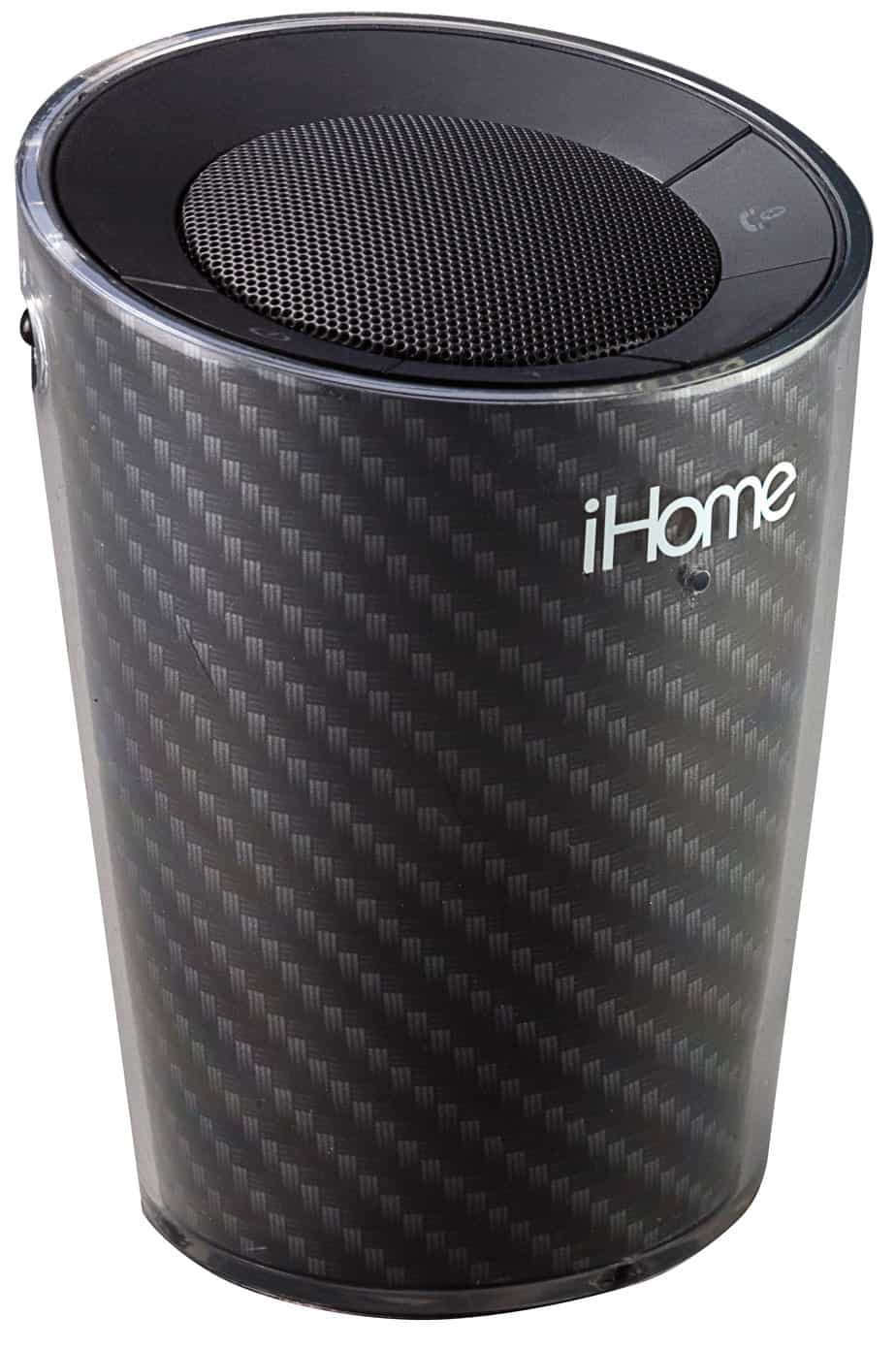 fits in a car cupholder, working as a speaker to wirelessly stream calls and music.
 The BlueAnt Commute Voice Activated Handsfree Car Kit is a smart way to read and send messages, and make calls handsfree. It offers what the company calls the best voice recognition in the industry, and drivers can prompt it to read an incoming message, reply to a message or dictate a new message without ever having to touch the phone.
Chargers. Smith also recommends a good dual device charger. The Griffin PowerJolt is one of many good options, he says. To charge an iPad, he recommends looking for one with a higher rating, such as the Just Wireless Dual USB car charger at Apple, or one from a local store with at least one 2.1 Amp USB port.
Shark fin antenna. This cool looking antenna sold by JuicedHybrid.com is aerodynamic and screws into the antenna base or can be attached with 3M adhesive.  Each antenna is custom painted and clear coated to match the paint code of the car.
Cellphone signal booster. If you’re going on a long trip or weekend getaway, the zBoost cellphone signal booster captures the signal outside of the car and amplifies it on the inside for a stronger “hands-free” signal.
A comfortable, clean seat. To protect your car seat from getting sweaty and stinky after you exercise, cover it with a NeatSeat. The easy-on, easy-off seat cover is made of plush microfiber and it slips easily over the headrest. Each NeatSeat comes with two seatbelt sleeves to protect the lap and shoulder belts from salty sweat stains.
A heated car seat cushion is another way to make Santa jealous. Debbie Anderson, who writes a blog about Christmas gifts, says she got one last year, and she’s given them to relatives as gifts. The heated car seats have elastic bands to hold securely in place, and plug into a cigarette lighter.
Turn up the volume. If you want chest pounding audio in your car, get the Terminator Party Pack enclosure from MTX Audio. The pack includes two 12-inch subwoofers in a sealed enclosure along with an amplifier. It easily fits into a trunk and will add some serious bass to a sound system.
Keep it clean. Cars can get dirty quickly, especially if you have pets. Laura Cruz of Dogtopia, a dog daycare franchise, recommends the Bissell Garage Pro Wet/Dry Vacuum with Wall Mounting System. This vacuum picks up wet and dry messes and has a long hose that stretches 32 feet.
To clean the outside, polish it with Meguiar’s DA PowerSystem. The tool allows you to polish the car like it would be done at a detailing shop. The system connects to a corded power drill so you can polish like a pro.
Driving school. No we’re not talking about car safety school that you go to when you get a speeding ticket, but a high performance driving class. Learning to drive like a pro racer might help you in the commute lane.
Lock up valuables in your car. Carrying an iPod, GPS unit and other expensive electronic gadgets every time you leave the car can be annoying. Lock them up  with the mySAFE Lockbox and keep them in your vehicle. The lockbox has a steel attachment cable to prevent a thief from striking quickly.
That should be enough to keep you entertained while driving. If not, grab a Star Wars severed Wampa arm ice scraper and have it at people when you’re not scraping ice off of the windshield.
General Motors and Chrysler are about to make it much easier to go green if you are driving a full size pick-up. They are going to start selling pickup trucks that can seamlessly switch between natural gas and regular old gasoline. These specialty trucks have two separate tanks and allow drivers to choose the fuel they want to use and if they run out of one type of fuel the truck automatically switches to the other.
The dual fuel ability of these trucks is an important step in the battle to win over customers who are interested in the cost savings and improved environmental impact of compressed natural gas (CNG) but have concerns about running of out natural gas in an area where finding a refilling station would be almost impossible. Having the backup of regular gasoline will hopefully give drivers the confidence to switch.
Currently there are only 1,000 CNG fueling stations across the country and only half of those are available to the public. Despite the low number of fueling stations almost all natural gas vehicle sold in the U.S are CNG-only which has limited sales. The reason bi-fuel vehicles have not been available before now is due to tax breaks that were only available for straight CNG cars and trucks.
This has limited sales of CNG vehicles. According to the latest statistics, there were only 112,000 CNG cars and trucks out on the roads as of December 2010. The majority of these are heavy-duty vehicles such as delivery trucks and city buses that are returned to a central base each evening to refuel. Passenger cars and trucks have yet to dent the market but GM and Chrysler hope to change that with these new pick-ups.
CNG offers big cost savings over regular fuel. What would be an equivalent amount of CNG to a gallon of gasoline runs about $2.00 cheaper than gasoline. As fracking and other processes have made natural gas more abundant in the United States the price continues to drop. Driving a CNG car could save the vehicle owner thousands of dollars a year.
Some of that savings will be eaten up by upfront costs. A CNG only and bi-fuel cars are more expensive than a pure gasoline version. CNG advocates are pushing for new tax breaks which would help buyers bring down the cost. GM and Chrysler are putting their bi-fuel trucks into the market regardless of whether the tax breaks become reality, mainly due to businesses looking to shave their operating costs.
Both the GM and Chrysler version of the pick-up will sacrifice some cargo space in the bed of the truck to accommodate the CNG tank but both will be able to handle the same cargo weight and towing capacity as the straight gas version of the truck.
GM recently announced that the bi-fuel versions would be available for the 2013 heavy-duty trucks, the GMC Sierra 2500 and the Chevrolet Silverado. While these vehicles will be available to the general public, GM predicts that businesses and fleet sales will make up most of the sales. Pricing was not available at the time of the press release.
Chrysler also announced a bi-fuel Ram 2500 which will only be available to fleet customers. The bi-fuel version will run about $12,000 more than the tradition gasoline version.
GM and Chrysler are introducing bi-fuel pickup trucks that will let users switch between compressed natural gas and regular gasoline. While these vehicles will cost more upfront, the fuel savings will quickly cover the costs. GM and Chrysler expect most sales to come from fleets and businesses but hope they will also convince the public to embrace CNG cars and trucks.
Just because a police car isn’t around doesn’t mean you aren’t being watched. School busses, mass transit busses, stationary cameras on corners, toll booth  cameras and of course red light cameras are catching driving infractions all the time. The issue of personal privacy is being challenged constantly.
A high profile case of such a camera incident was captured recently in Cleveland, OH. A school bus driver constantly noticed a driver pass them while they were stopped with there no passing sign and lights on. A camera was installed and the driver was caught in the act. The driver was appropriately punished.
Toll booths in need of revenue don’t rely on a toll booth operator to write down a license plate when a driver doesn’t pay. High tech high-resolution cameras snap a picture of front and back license plates as soon as it is realized that the toll was not paid. Toll skippers have gone as far as having a passenger ride on the tailgate in order to obscure the license plate. Although it may work this time, it is a dangerous move in order to save a few dollars.
The most helpful traffic camera, and the one capturing one of the most dangerous maneuvers, is the red light camera. Most systems are designed to start filming so to speak when the vehicle enters the intersection when the light is red, so there is no debate that the light was still yellow. A high-speed camera then snaps a picture of the car and license plate. Some states cannot surcharge the diver however since usually they can not be positively identified. Strangely enough some states actually allow a second to go by after the light turns red before citing a violation. Several states have red light camera systems but some are also starting to repeal them. Although several studies tout the effectiveness of red light cameras, a countrywide trend has not taken place. Anti-red light camera activists cite legal and privacy issues against them, and they believe the cameras do not improve safety. Another controversy is that some believe certain municipalities install the cameras just to increase revenue and manipulate the yellow light time in order to get more red light runners thus more fines.
The newest high tech weapon against scoffers is the automated license plate scanner. A system scans license plates at sixty plates per second. The goal is to catch anything from an expired registration to a stolen car to a wanted fugitive. Perhaps one of the highest debated privacy issues since it tracks you regardless of what you are doing.
Studies show there really is no debate when it comes to the effectiveness of all of the mentioned traffic cameras. The problem boils down to manipulation by officials in order to increase revenue and privacy. Privacy is a big concern in the digital age. On purpose or not activities can frequently be caught on camera and the debate rages on as to what is private and what is public.
During the holidays driving and even parking become more hectic than usual. There are mad rushes to get out of work early, mad rushes to the mall, and mad  scary rushes to the in-laws. There are precautions to take when making the holiday rounds.
The craziest place to be may be the mall. Crazy anxious drivers, entitled drivers, and distracted drivers make the mall parking lot a virtual obstacle course. One thing to remember is that it is still a “road”, and driving rules still apply. Stop at the mall stop signs, yield signs, etc. One way signs in malls mean the same as one way signs on public roads. The typical 15MPH sign should especially be obeyed in the mall with dozens of pedestrians wandering aimlessly between cars and crossing lanes. If someone steals your prime parking spot after you sat there with your blinker on for five minutes, let it go, no need to fight over a parking spot. However, when parking at night make sure the area you are parked in is well lit. Be aware of your surroundings coming and going from your vehicle, especially when returning to your car with packages. A distracted casual shopper with expensive gifts is a prime target for a robber. If you are going back and forth from your car with bags, lock them in your trunk out of sight. If at all possible try to go shopping with a partner or in a group.
Holiday driving during the season is always hectic, even when not on the actual day of the holiday. Maniacs are rushing to others houses for parties and of course constant shopping traffic. Due to holiday festivities there are usually a higher number of driving while intoxicated incidents. There will be more cars on the road. Plan your trip accordingly. Anywhere you are going, if you are in a time crunch, leave early. Unfortunately if you work near a mall and don’t have the luxury of leaving early, you may want to wait for some down time before leaving. Since malls have a diverse demographic, traffic appears from everywhere. Of course if you are going to a holiday party don’t drink and drive. Try not to stay too long at a night party; the worst drunk drivers are out in the later hours, especially after midnight. If going to multiple destinations map out your trip. Doubling back not only wastes gas it wastes time and adds to frustration, and try to do all shopping errands for the day in one trip. Traveling to the in-laws or the immediate family used to be fun as a child, now you’re an adult and now you know why your parents grew more gray hairs at the holidays. Since you are stressed enough as it is, try to leave as early as possible when visiting relatives no matter how far away. It can also be a good excuse to leave early since you can say you have to beat the traffic.
Holiday unfortunately have become a stressful time of year. Take the stress of driving off of the list and plan accordingly.
David Bakke has a young son and lives in Atlanta, Georgia. He shares his insights related to money management and insurance on the blog, Money Crashers Finance.
Kids are expensive – no doubt about it. And just as they get older and you think you’ve made it through the expense avalanche, bam, they go on your car insurance policy. According to a recent study, adding just one teen driver will raise your premium by an average of 44%. But instead of cutting off your teenager, try these tips for adjusting your insurance to offset this increase.
1. Raise Your Credit Score
Most insurance providers factor in your credit history when quoting you a premium, so one way to balance out the impact of adding kids is to raise your credit score. Pull your credit report for free – everyone’s entitled to one annually from each of the three reporting agencies – and check it for errors. Believe it or not, mistakes do happen, and you could be paying more for something you didn’t do. Then start paying your monthly bills on time and reducing your credit card balances. This has a huge effect on your score and could very well impact your rates.
2. Shop the Competition
Instead of spending hours on the phone or online waiting for quotes, enlist the help of a professional to do the legwork for you. Independent insurance agents offer unbiased insight on where to get the best price. They’re indebted to no specific company, and their sole goal is to get you a good rate. It makes no difference if you get you’re insured by 10 different companies in 10 years, as long as you’re getting a fair deal and the agent and insurance company are legitimate.
3. Review Your Coverage
Once your car is paid off, you can look at dropping certain coverages to save some dough. Some will tell you to drop both comprehensive and collision if your car doesn’t have much value, but I would reconsider letting go of comprehensive auto insurance coverage, which covers potentially expensive damage to your car, such as fire, vandalism, theft, and forces of nature. The $10 a month you save on your payment today will seem very sad if a storm damages your car tomorrow.
As for collision, the collective wisdom is that if your car is seven years or older and your collision premium exceeds 10% of the car’s value, you should consider dropping it. Another option if you still owe on your car is to raise your deductibles. Just don’t do it without considering the risks. If you raise your deductible from $500 to $1,000, make sure you have an extra $500 tucked away somewhere so you don’t get burned in the event of an accident.
4. Stay in Touch With Your Agent
I’ve had the same insurance agent for 12 years. I actually meet up with her for lunch a few times a year, not so much because I love her company but because things change in people’s lives, and when they do, it can affect the rate you pay. A thorough conversation keeps us up to date. As you age, your premium gets lower. Getting married also has a positive effect. Have another baby? Yes, that could lower your rate as well. Even a switch in jobs that results in a shorter commute might reduce your premium. The point here is that communication is key, so keep your agent in the loop.
Final Thoughts
To see if you can save on your auto insurance and improve your driving habits, go to the Progressive website and request a free device called Snapshot. You install it on your car, and it monitors your driving habits for 30 days – including mileage driven, rapid accelerations, and the amount of sudden stops. If you’re a safe driver, Progressive might offer you a discount of up to 30%. Whether you take that policy or not, you gain insight into your driving style. Any or all of these moves could lower your rate and reduce the sting when your teen is ready to hit the road.
How else can you reduce your premium when you’re adding a teenager?
Eco-car makers are hoping to receive a boost from the Obama administration, at least in the form of the continuation of the tax credits and subsidies that were a hallmark of  his first term. They’re also hoping that Obama expands his support of the industry in the next four years by raising the tax incentive to buyers of green cars from $7,500 to $10,000. Whether this hope becomes a reality remains to be seen, especially in light of the fact that the House of Representatives still remains under Republican control.
During the first four years of the Obama administration, an estimated $80 billion of the stimulus recovery program was funneled into grants and loans to help move the country toward alternative energy programs, companies and research.
Despite the fact that alternative vehicles are becoming increasingly popular in the U.S., the struggling industry still needs considerable federal support, with battery-powered car sales totaling only 20,000 units in 2011. Electric plug-in cars have also met with less consumer enthusiasm than anticipated, with sales of the Chevy Volt totaling less than half of its target projection for 2012.
Another deterrent to the growth of the green auto industry comes in the form of federal loan debt repayment. Automakers Tesla and Fisker, which both received low-interest loans from the government, have been under congressional pressure to repay their debt more quickly than anticipated. Both companies have struggled to launch new vehicles on the market as a result of the debt pressure. Debt repayment became an issue when the solar cell manufacturer Solyndra declared bankruptcy after borrowing more than $400 million from the federal government.
The Electric Drive Transportation Association, a representative agency for electric and hybrid carmakers says that it “Looks forward to continuing its work with President Obama and the newly elected Congress to advance technology that will diversify our transportation fuels.”
A pilot program in California is giving new meaning to the term ‘green’ by adding ocean algae to the list of alternative bio-fuel ingredients. The fuel, made by San Francisco- based Solazyme, Inc., is a mix of 80% diesel and 20% algae-based bio-fuel. It’s known as B20, and is being tried out at four gas stations in the San Francisco area in hopes that it will be expanded to nationwide sales.
The trial program will run for a month. Its continuation will depend on customer response. “Today, at this station, we are putting a stake in the ground,” said Matt Horton, chief executive officer of Propel Fuels, as the first tank of B20 was being filled at a Redwood City gas station. “We hope to build hundreds of stations like this in California.” He added that the supply of bio-fuel in California currently doesn’t meet the million-plus cars on the road in California that are able to use alternative fuels.
Solazyme’s B20 is made from algae oil produced in stainless steel tanks in Peoria, Illinois using a fermentation process. The finished product produces 10% less hydrocarbon, 30% fewer particulates and 20% less carbon monoxide than other diesel and biodiesel fuels. In addition to auto fuel, it’s processed into jet and boat fuel at a biodiesel production facility in California.
B20 offers a great alternative to corn-based ethanol, which is the most common bio-fuel in the U.S. Environmental advocates are wary of ethanol made from corn, because its production has a high environmental cost. Studies have shown that corn-based ethanol produces just a little more energy than it uses to produce. Also, last summer’s drought caused corn prices to skyrocket, making it more expensive to produce. Because algae is produced naturally in the ocean, B20 would presumably have no such price fluctuation.
At $4.25 a gallon, the new algae-based gas product sells for about the same price as regular diesel fuel. It complies with the low carbon fuel standard enacted in California which requires fuel producers to lower greenhouse gas emissions in their products 10% by the year 2020.
Bob Ames, vice-president of Solazyme, says that his company’s algae-based bio-fuel is a way to employ “… some of the world’s smallest microorganisms to solve some of the world’s greatest problems.”
Child car seats are one the most important safety issues when driving. A simple but important law has been changed in Maryland. Children must stay in a car seat or boosted seat until they are eight years old, regardless of weight. This is intended to keep children as safe as possible, as it is believed the age of the child is more important in determining safety than the weight category.
On a national scope The National Highway Traffic Safety Administration conducted a study on common car seat mistakes. All the issues noted were simple mistakes, but extremely important. The wrong harness slot was used; the harness can be adjusted depending on the child’s size and weight. The harness chest clip was not positioned correctly; it must be across the chest. The harness itself must have no slack, cases showed usage where there was slack. There was too much give in the securing of the seat itself. The seat must only move an inch front to back or side to side. An important problem here is knowledge. 20% of the drivers with child passengers didn’t even read the installation instructions yet, 90% felt their installation was correct.
There are several resources available to check the integrity and installation of a child car seat. An organization called, Safe Kids, in partnership with the NHTSA, offers several simple steps to check for the appropriate seat and installation. First off the car seat advises the proper age, height and weight for the car seat. Also, child products are constantly recalled, periodically check to make sure your car seat is not on a recall list. Always seat the child in the back seat; children should not be in the front seat until they are 13. New guidelines now advise to keep a child in the back seat rear facing until they are at least two years of age. After installation of the car seat make sure there isn’t too much wiggle room. From front to back, and from side to side, the seat should not move more than an inch. Once the child is seated the harness should be at chest level with no slack. There is a pinch test, if you pinch the fabric or try to you shouldn’t be able to get any slack. Different cars have different features to securely fasten a car seat to the back seat. There are anchors above the headrest and at the seam of the seat cushion, refer to your particular car’s manual for proper location of the anchor devices.
Child car seats are an important safety feature that should not be taken lightly they should be properly installed and a child should never be out of one when a vehicle is moving. The seat should be constantly checked and secured appropriately.
If you are headed out to the mall on Black Friday there is a good chance that you will be in a parking lot accident. According to the National Retail Federation (NRF), last year 77 million people planned on hitting the shopping centers on Black Friday which translates into a lot of people competing for a limited number of parking spots.
This year could be even worse. An improving economy has the NRF forecasting that holiday sales should shoot up 4.1 percent this year, hitting $586.1 billion dollars. Experts estimate that 20 percent of all car accidents happen in parking lots and claims tend to skyrocket around the holiday shopping season. While rear-end collisions tend to be the most common, it is also possible to be t-boned in a parking lot while backing out.
In most cases, parking lot accidents occur when vehicles are moving slowly so the damage is often not extensive but that doesn’t mean they won’t affect your insurance premiums. Even a low dollar claim affect insurance rates so it is best to be very careful when shopping.
Common Parking Lot Accidents
The type of accident you have will determine your next move. Here are a few tips on how to handle the most common Black Friday parking lot accidents:
Moving accidents are fairly common in parking lots. If you hit, or are hit by another moving vehicle experts advise to contact the police. This gives you an official record of the incident and will help determine who was at fault. In many cases the police will refuse to come out for a minor accident. Exchange information on your own and let your adjuster determine who was at fault.
See if you can find any witnesses and try to get their contact information which you can pass along to your insurance company. Be sure to take plenty of photos before you move the vehicles and write down a detailed description of the accident as soon as possible.
Hundreds, even thousands of parked cars in one place is bound to lead to a few of them getting dinged up. If you smash into a parked car you should do the right thing and leave a detailed note with your contact information. This is not only good karma, in most states it’s the law. If you fail to leave a note you are guilty of hit and run which will dramatically raise your insurance premiums, and may even result in cancellation. Many shopping centers have video cameras in their parking lots so don’t be surprised if the police show up at your door a few days after the incident.
If your vehicle was hit and there is no note on the windshield, you will end up having to make a claim on your collision coverage. You will have to cover the deductible and despite having no blame in the incident, there is a good chance your rates will go up. You should certainly call the police and request mall security to review any videos, you may get lucky.
A Few Tips
Here are a few tips on how to stay safe and accident free during on Black Friday:
- When you are backing out, look carefully for other vehicles as well as pedestrians.
- Keep an eye out for vehicles that are driving diagonally across the parking lot.
- Drive slowly in the parking lot and use your indicators at all times.
- If you have a back-up camera on your car, use it.
- Consider doing your shopping online.
- Mail Christmas cards early, Post Office parking lots can be the most dangerous.
- Park at the end of the lot to avoid dings.
- Lock your car and cove up visible packages, break-ins are much more common during the holiday shopping season.
CarFax was awarded two patents in recent months which highlight how the company services can tie a vehicles history to how insurers price insurance for the same vehicle. The patents were awarded in August by the U.S. Patent and Trademark Office (USPTO) and protect the company’s rights to “apparatus and method” for rating and underwriting insurance policies based on data from the vehicles history. This system, according to the USPTO filing can enhance the underwriting of an insurance policy for vehicles based on scores produced by the system using the vehicles background.
Experts say that while insurers have always looked at the type of car being quoted, taking the history of a specific vehicle into account is a brand new concept. In the past, insurers have used CarFax data to check if a vehicle has been damaged by flood, fire or has been issued a salvage title. The latest, and now patented system would let insurers access information regarding air bag deployment, the number of owners as well as hail damage reports. Studies have shown that prior damage is often linked to incidents of further damage. Using this information insurers can properly rate specific cars.
Patents 8255243 and 8255244 should have more and more insurers working with CarFax, a company that already works with many top name insurance clients.
The newly patented systems incorporate several variables which can be used by insurers. Accident, title and mileage data is key to an insurers evaluation of a vehicle. Odometer readings help insurers assess the miles traveled in a vehicle which can be incorporated in actuarial tables. It can also be used in the investigation of claims. All of this allows for more accurate rates, which is good for both insurers and customers.
Weather Events Make Vehicle Histories More Important
The recent Superstorm Sandy has highlighted the importance of vehicle history reports to insurers. Several groups have issued consumer warning in regards to flood damaged vehicle making their way into the marketplace. Less than honest resellers and auto dealers could attempt to sell flood-damaged vehicles without disclosing the damage to potential buyers.
Using a vehicle history report like CarFax can help consumers and insurers identify vehicles that have been damaged by storms such as Sandy. Going a step further, state officials have promised to help out in identifying possible flood damaged vehicles. Jesse White, Secretary of State in Illinois recently announced that his office would screen title applications for vehicles that are coming from areas that were affected by Superstorm Sandy. In order to get a clean title in Illinois a Hurricane Disclosure Statement will have to be signed by the registered owner of the vehicle as well as an insurance agent. The latest CarFax technology should be able to help with this requirement.
Saltwater can severely damage a car and create both corrosion and electrical problems long after the exposure to the water. This makes it important that consumers and insurers check out the history of a vehicle before making an offer. Flood damaged vehicles often have much shorter lifespans and are likely to require costly repairs.
Newly patented technology from CarFax will allow insurers to use a vehicle history report to help determine an accurate premium.

Remember the old commercials with the crash test dummy hurtling unbuckled through the car windshield? Those ads, which were targeted toward getting people to use seat belts, have gone the way of the ivory billed woodpecker. Nevertheless, statistics show that people are buckling up at a record rate.
According to figures just released by the National Highway Traffic Safety Administration, 86% of U.S. motorists are using seat belts. Compare it to 58% of motorists buckling up 1994. This record number has played a big part in the dramatic lessening of crash fatalities in the past ten years.
In response to the increase in seat belt use, Secretary of Transportation Ray LaHood issued a statement saying, “When it comes to driving safely, one of the most effective ways to protect yourself and your family is to use a seat belt.” LaHood says his organization will push to increase seat belt use even more during the impending holiday season, which traditionally sees an increase in auto accidents.
Part of the rise in U.S. seat belt use is credited to the South, which has seen a significant increase in the past few years. The region has historically shunned seat belts, but the figure has risen from 80% to 85% in the past year. This increase is attributed to law enforcement efforts to enforce seat belt laws. Washington is the state with the highest seat belt use at 97.5%, and Massachusetts comes in at the bottom with only 73.2% of motorists buckling up.
All U.S. states except New Hampshire now require motorists to wear seat belts. Of those states, 32 of them make non-seat belt use a primary offense, which allows law enforcement to pull over a driver and issue a citation for non-compliance. In states where it’s a secondary offense, it can only be cited in conjunction with another offense, such as speeding.
The NHTSA estimates that a 1% rise in the use of seat belts saves 220 lives yearly and prevented approximately 72,000 fatalities between 2005 and 2009. Last year’s traffic fatalities totaled 32,310.
GE4NTGZ9MRZD
When automobiles first started showing up on city streets, they were thought by some to be a passing fad. As of 2009 there were over two hundred and fifty million cars and  light trucks registered in the United States per the US Bureau of Transportation Statistics. This didn’t include larger trucks and motorcycles. Even in the early years laws had to be made to address the growing “fad”, some stranger than others.
In 1901 Connecticut was the first state to enact a speed limit. The city limits maximum allowed speed was 12 miles per hour, but you could let loose outside the city at 15 MPH. The fastest sprinter runs over 15 MPH. Even earlier the UK had a “locomotive law”, that required a person to walk alongside the vehicle waving a red flag to let others know it was coming, and to pace its speed, since it was only allowed to travel about 2 MPH. in 1903 New York issued the first set of uniform traffic rules. As late as the 1930’s several states had no speed limit and some didn’t even require a license to drive. A national speed limit was not enacted until 1974, set at 55 MPH. Although the early laws seemed ridiculous, at the time they were sensible; since nobody had any idea how fast a vehicle could go. There are some that may seem strange, or based in morals as opposed to laws and safety.
In South Carolina drivers can be cited for displaying what is seen as obscene material, such as parts of the human anatomy from your bumper. Other states have laws that even if you aren’t driving but the driver are drunk and you are as well, you will be arrested for drunk driving too. Arizona actually has a law that you cannot drive in reverse. This would be very difficult to avoid at the local grocery store, so get there early, pull in head first through two spots so you won’t have to back-up when you leave, and I hope you have a circular driveway. In California no vehicle may travel faster than 60 MPH without a driver, I think everyone can agree on this law. Parking comes with its own problems. In certain parts of Florida you are not allowed to park your pick-up truck in front of someone else’s house. Indiana does not allow backing into a space since the police can’t see your license plate. The Texaco Man would be pleased to see the gas pumping laws in NJ and OR, you can’t pump your own gas in those states. Oregon actually carries a $500 fine if you are caught pumping your own gas.
There are laws to address just about everything to do with an automobile, some addressing the safety of the time, some on moral grounds, some just silly. All states and towns across the country have had odd if not at least different automobile laws since they realized the “fad” was here to stay.
As the flooding from Hurricane Sandy recedes and the damage figures climb, the numbers of automobiles impacted by the storm are beginning to roll in. So far, estimates  show that as many as 266,000 new and used vehicles will be heading to the junkyard as a result of the storm. Of that figure, manufacturers report that 16,000 new vehicles were lost, a number that would have been much higher if many of them hadn’t been moved prior to the storm as a precautionary measure. Of the vehicles that were damaged, most were in storage at the port of Newark when the massive storm pounded the coast of New Jersey and New York.
The nation’s two largest automakers, General Motors and Ford, haven’t announced how many new vehicles they’ve had to scrap as a result of Sandy. When those figures come in, the 16,000 total likely will climb higher.
New car sales are expected to rise in next few months, as many people begin to replace vehicles that were lost in the storm. Financial relief is being offered to buyers by all of the major manufacturers, with some allowing deferred payments for three months to customers in areas impacted by Sandy. Other deals for Sandy victims who lost vehicles include $500 in credit from Ford, Chrysler and General Motors, and $750 from Hyundai. Nissan is also offering special discounts for those who lost vehicles in the affected areas. Honda has issued emails to customers in the damaged region, promising deferred payments to customers who repurchase vehicles from their dealerships.
The storm dampened auto sales in late October, with Toyota estimating a loss of 30,000 vehicle sales as a result of the turmoil. It’s expected that sales in November and December will more than make up for the loss, as consumers begin to head back into dealerships, many of them replacing lost or damaged vehicles.
New car and truck losses reported by automakers includes 6,000 vehicles from Nissan and 4,900 from Toyota. The highest figure so far comes from eco-car maker Fisker Automotive, which reports 330 luxury Karma hybrid electric sedans were lost at the port of Newark, totaling $33 million dollars.
By Aaron Crowe
Cooking a Thanksgiving meal doesn’t have to be stressful. If you’re driving for four hours or so on Thanksgiving Day, let the car do the cooking for you.
While it may not sound appetizing, cooking on a car’s engine can be done safely, according to experts.
There are some caveats: You won’t be able to fit a whole turkey on the engine block, and you’ll have to drive for four hours.
But if you’re willing to give it a try — and your relatives and friends are too when you arrive at their home — then a boneless, 5-pound turkey breast with vegetables can be cooked on the drive to grandma’s house.
For a long-winded video introduction on how to cook a Thanksgiving meal in the car, try this three-part series on YouTube. It’s informative but takes a while to get through.
It might be quicker to try finding the 2008 book “Manifold Destiny,” which has a recipe that USA Today wrote about in 2009. Here’s the recipe:
To Grandmother’s House Road Turkey
- 1 Boneless turkey breast, about five pounds, sliced into thin strips against the grain
- 3 large baking potatoes, peeled and diced
- 3 carrots, finely diced
- Dry white wine
- Flour for dredging
- Butter for greasing foil
- Salt and pepper to taste
- Three-quarters cup heavy cream
1. At home, combine the turkey, potatoes and carrots into a bowl with the wine and cover. Marinate two hours in the refrigerator, then drain well (and don’t drink the wine). Setting the vegetables aside, dredge the turkey pieces in flour, then heavily butter five large squares of foil. Arrange equal amounts of turkey and vegetables in each square, and season with sale and pepper as desired. Cup the foil around the turkey and vegetables, and pour over each serving as much heavy cream as you can without making a soupy mess, then seal carefully.
2. Cook on the engine about four hours, turning once. We’re assuming grandmother doesn’t live in the next town.
That’s it. Make sure the food doesn’t block air flow or engine wires, and be sure to turn the engine off when turning the meal when it’s halfway done. Side dishes will have to be made at grandma’s house, or someone else can warm a side dish on their engine.
Other ways to cook
Cooking on a car engine isn’t the only odd way to cook a turkey. If your oven doesn’t work properly, as happened to Larry and Rachel Gebaide when they opened their catering business, Tastebuds Catering, in Florida in 1995.
An oven they bought had only one temperature — broil. Larry Gebaide cut a turkey in half and used a dry run of seasoning and flour to took half of a turkey on the bottom shelf of the oven under the broiler for about an hour. He put the turkey in pan with about three inches of water and basted it every 20 minutes. Once the bird was browned he covered it with aluminum foil. The oven got to about 475 degrees with only the broiler on, Gebaide says.
“Out of desperation you try different things, and it just happened to work,” he says.
The caterer continues cooking turkeys at a high temperature — 450 degrees — allowing him to cook a full turkey in half the time it would normally take.
“It works well and we’ve been doing this for for 18 years,” Gebaide says.
For truck drivers who are stuck on the road on Thanksgiving Day, cooking a Thanksgiving meal on their engine may not be an appealing idea if they don’t want to drive on the holiday.
The website Truck-Drivers-Money-Savings-Tips.com doesn’t recommend cooking on an engine, but it offers meal preparation tips for cooking in the tight space of a truck cab or sleeper berth area by using appliances powered through an inverter that can plug into a cigarette lighter or to one of the truck’s batteries.
A portable outdoor grill may be the easiest way to cook on the road, though it doesn’t sound as exciting as cooking on your car engine.
Aaron Crowe is a writer in the Bay Area who specializes in personal finance topics for CheapCarInsurance.net.
A New Jersey requirement that placed identifying decals on the license plates of teen drivers is having a big impact on accident statistics. According to a study released by the Children’s Hospital of Philadelphia (CHOP), the decal requirement, which is known as Kyleigh’s Law, has reduced the number of teen driving accidents by 1,624 since it went into effect in 2010.
The law requires drivers from ages 16 to 20 years of age to place the decal on their front and rear license plates. The decals, which cost $4 for a set of two, are made from a highly reflective material, alerting law enforcement to teenage drivers and helping them to enforce restrictions under the Graduated Driver’s License (GDL) program.
“The number of crashes prevented is equivalent to the number of students attending a large high school,” said Dr. Allison Curry, the medical director at CHOP. “New Jersey youth and other road users are safer as a result of the decals.”
Kyleigh’s Law is named for Kyleigh D’Alessio, a 16-year-old New Jersey teenager who was killed in a car crash in 2006. The vehicle was driven by a 17-year-old who was violating the GDL restrictions by driving with three passengers in the car. The GDL restricts the number of passengers a teenager can have in the car in an effort to reduce accidents. Studies show that more passengers results in a distraction that increases the likelihood of a crash among teen drivers. Other GDL restrictions include the hours that teens can drive and the use of mobile devices in states where they’re otherwise permitted.
The CHOP study is the first of its kind to identify the effect of the decals on accident rates. The study also revealed that citations to teen drivers rose by 14% as a result of the decals.
Decal requirements similar to Kayleigh’s Law are being considered in North Carolina, Michigan, Iowa, Minnesota, Alaska and Kentucky.
Super storm Sandy recently wrecked havoc all over the east coast. Coverage of the disaster showed submerged and flooded cars everywhere. Some of these cars will be repaired and kept by their current owners; many more will be totaled by an insurer and sold to rebuilders. While there are many honest rebuilders out there, some are less than thorough when they rebuild the cars and put them back on the road. If you end up in an improperly salvaged car, or one that was simply allowed to dry out, you could be setting yourself up for a big headache.
While experts predict that the number of flood-damaged cars hitting the market will be nowhere near as bad as Hurricane Katrina there is no doubt that some will make it into the used car market soon.
How do these cars end up back in the marketplace? When an insurance company totals a damaged car they are often sold through auto salvage auctions. These cars can end up thousands of miles from where they were flooded. They may be purchased by rebuilders, or even used car lots that either rebuild them, or simply freshen them up before trying to sell them.
In most states when the insurer totals the car it is issued a salvage title, which alerts future buyers that it has been damaged. Cars that have a salvage title are only worth a fraction of a clean title vehicle. Unfortunately, less than honest buyers will move the cars between states until they manage to get a clean title issued. This is called title washing.
In addition to unscrupulous rebuilders, owners will sometimes attempt to sell their flood-damaged vehicle without informing potential buyers that the car has been in a flood.
If you are in the market for a used car, knowing how to spot a flood-damaged car can save you tons of money and trouble.
How to Spot a Flood Damaged Car
Smell – A flood-damaged car will smell. It will have a musty odor to it. The seller may try to cover this odor with deodorants, perfumes or other overpowering smells. If the car has a unusually fresh or overwhelming perfume smell to it you should further investigate the car before making an offer. The smell of the car is often one of the first things you will notice.
Look for Moisture – Cars that have been flooded will show signs of moisture damage. Check the gauges on the dashboard for moisture and be sure to test all of the switches. Turn on the lights, wipers, turn signals, radio and heater. Check wiring under the dashboard, if it is cracked there is a good chance the car has been flooded.
Rust – Check for rust in the trunk, engine compartment and other areas where water would not usually get in. Check under the interior carpet and even behind door panels if possible. If you find rust where it should not be, move on to another car.
Mud and Crud – Check for mud and other debris in the engine compartment and other areas where it shouldn’t be. Even the glove box can have signs of damage and rust. Get under the dashboard and make sure there is no mud, or dirt which would be a sure sign of flood damage.
Do a VIN Check – You should pull a CarFax or other VIN check on any car that you are considering. If the car has had a salvage title issued this should be listed on the CarFax. This is a fairly inexpensive way to find any problems a car has had in the past.
While flood damaged cars will often develop engine and electrical problems if they are not fixed correctly, this doesn’t mean it’s impossible to buy a properly rebuilt car. If a car is completely stripped down and the carpets, seat foam and airbags are properly replaced a salvage title car can be a good buy. It is best to know the rebuilder or have a friend’s recommendation. Before final payment have the car inspected by a trustworthy third party mechanic to make sure the rebuild was done correctly.
Flood damaged cars can be a major headache, knowing what to look for will help you avoid a lemon.
Have you ever been denied automobile insurance but you don’t know why? Some states have laws that designed to protect individuals against insurance discrimination.  Massachusetts is one of those states.
Massachusetts has enacted the Consumer Bill of Rights for Automobile Insurance. Not only does the bill protect against discrimination with regards to securing auto insurance, it has other measures attached to protect the consumer for unfair pricing and billing practices. Check with your state’s Division of Insurance to see if your state has laws enacted to protect the automobile insurance consumer.
Massachusetts states you have the right to buy insurance. This seems rather odd, of course you should be able to buy insurance, but it means you can’t be denied for no substantial reason. You can’t be unfairly discriminated against for insurance based on obvious factors such as race, religion, gender, but it goes further to state no discrimination with regards to marital status, occupation, income, garaging, home ownership and education. If you are denied insurance you have the right to know why, if you are denied an answer, or you feel the answer is discriminatory, you may file a complaint with the Division of Insurance. Massachusetts has a “pool” for drivers denied insurance in the open market. If after several attempts to secure insurance you are continuously denied for sufficient reason, you may apply to the state and be placed in pool, called the Massachusetts Automobile Insurance Plan. The rates are typically higher, and these are considered higher hazard drivers for one reason or another, so be sure to shop before applying to MAIP. Massachusetts actually publishes the rates for all carriers operating in their state, and this information is available to the general public for research and shopping around.
The state goes even further to protect the consumer. You cannot be forced to purchase coverage’s that are not mandatory or not required by your lien holder. If you want only basic coverage by law, and what is required by your bank, you may do so, an agent cannot force you to buy higher limits. The rates you do purchase must be subject to legitimate underwriting criteria and not unfairly discriminatory, such as the reasons for denying coverage that are discriminatory. As long as you have not failed to pay policy premiums in the past, you cannot be forced to pay more than a 30% deposit when a new policy is written or renewed. You must be notified with regards to policy cancelation or non-renewal within a specific time frame, and adequate reason must be given, you also have the right to appeal this decision. You also have the right to cancel the policy yourself at any time, but the insurer does have the right to issue a fee or penalty is the policy is canceled after inception. Fair claim handling and notice of claim decisions is also a right. Claims must be handled fairly, and if it is determined you are at fault you have the right to be notified as to why you were at fault. Your insurance company must keep your personal information private, and it is their duty to make sure your date is safe from hackers or others trying to secure confidential information.
Finally, a consumer can always filed a complaint with the Insurance Division, it is also a right. Again, be sure to check your specific state with regards to rules and regulations to do with automobile insurance and your rights.
Car repairs aren’t just costly, they can be a nuisance. When your car is in the shop you lose valuable time waiting for it, you might have to bum a ride from someone else or take public transportation. In order to make the hassle worth it, make sure your mechanic can be trusted.
The first positive sign of a good mechanic is volume. If there are several vehicles waiting to be worked on, or you have to schedule service a few days in advance, like a good restaurant, the mechanic should be good and is popular. There are two things to watch for however if they are busy. Notice if the same cars are there after two or more days, if they are, they may just be slow. If there seems to be a quick turnover, the car you saw this morning is gone this afternoon, then they most likely are efficient.
Is the mechanic or the one who schedules you friendly but not too friendly? If the person seems to be genuinely folksy and down to earth, then they may be an honest mechanic. Try to make small talk or talk in general about the cost of everything nowadays and see how they react. If you can bring a small child with you see if they interact with the child, and not in a fake overbearing way. It may be a little psychological, but go with your gut and decide if the person seems genuine. If they can talk person to person with you and look you in the eye, hopefully they can be trusted, or they are running for office!
Don’t let them scare you into extra work. If you drop your car off for an oil change, and everything else seems to be running fine, be suspicious if they call you and start rattling off problems. If you truly believe there could be issues take your car somewhere else for a second opinion. Never drop your car off for any service and give them carte blanch. If you feel there may be multiple issues with your car and you are not quite sure what the problem is, have the mechanic go over the car first and then contact you with the problems they have come across. Do not tell the mechanic to go ahead and do whatever is needed first; this could result in thousands of dollars of unnecessary work. Perhaps you do need new tires or brakes but maybe it is not dire, and you have a few thousand more miles to go. Along these lines as well, don’t let them scare you into repairs.
Check online for reviews of the repair shop. Try to find a site that has several reviews, one or two reviews could just be planted. Make sure the mechanic is certified and appropriately licensed by their state. Finally, don’t be afraid to leave and get a second opinion. They may have charged you a fee for diagnostics, but if the recommended repairs are through the roof, it may be worth it to take your car elsewhere to make sure you aren’t getting taken.
There are some perfect, or be it lucky drivers out there. There are people who seem to never have car trouble, never get in an accident, or never even get a ticket. For most of us  however, one of the three has happened at least once. There are things that should be done if any or all three events occur.
You are driving along a pretty busy highway when all of a sudden your tire blows. The first thing to do is to try and maintain control of the vehicle. When control is achieved immediately signal to leave your lane, and enter the breakdown lane or appropriate shoulder, as carefully as possible. Once in the breakdown lane, immediately turn on your hazard signals, and come to a controlled stop. Trying to change a tire on a busy highway is a dangerous situation, and should only be performed in a breakdown lane or shoulder that is several feet away from passing traffic. If you decide not to change the tire yourself, call a road service company or the highway patrol, and remain in your vehicle until help arrives, this goes for any type of break-down that may occur. Several people are killed each year as pedestrians on the highway as they attempt to repair their car, or are just outside the vehicle waiting for assistance.
Being pulled over by the police can be unnerving for anyone. If you believe it is a legitimate law officer attempting to stop you, pull over as soon as possible as long as it is safe to do so. If the vehicle seems suspicious to you, since it may be unmarked, pull over but call the police to verify the identity of the officer. When it is determine it is a legitimate traffic stop, do not make any sudden movements, and obey the officer’s instructions. If you feel that you have done no wrong do not get into an argument with the officer, arguing could only make matters worse, responding calm, cool and collected may make the officer let you off with a warning. If after all this you still receive a citation, again, save the argument for a court date to appeal the ticket.
The scariest situation of all three is the traffic accident. It is helpful to keep a pen and paper handy if an accident happens. If you are in an accident with minor damage, pull over safely and exchange information with the other driver. Do not try and discuss who is at fault, and don’t admit fault even if you believe the accident was due to your driving. Write down the other driver’s license plate, and ask to see their license and registration. Even if there appears to be no damage and no injuries, still obtain all the information, do not let the other party try to brush off the incident. There could be unseen damage to the vehicle, or injuries that can’t be immediately felt. Also, note all individuals at the accident, some parties try to add occupants to vehicles after an accident in order to fake injuries and obtain more claim money. Finally, if the accident does seem serious enough, or the other party is not cooperating, call the police immediately for assistance. Most accidents reported to an insurance carrier will require a police report regardless.
If you are one of the lucky ones maybe none of these unfortunate incidents may happen to you. If you are not so lucky, being prepared and aware is a great tool to have against any problem that may arise when on the road.
Young drivers or inexperienced operators unfortunately are involved in a higher percentage of accidents then more experienced drivers. It is just nature that it takes time to 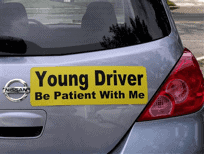 fully learn something and be good at it, be it golf or driving a car. It appears the phenomenon of inexperienced driving however is more a problem with inexperienced young drivers, as opposed to someone who gets their license later in life. During their first six months of driving inexperienced drivers are eight times more likely to be involved in a fatal accident then experienced drivers, per the Insurance Institute for Highway Safety. Insurance rates are adjusted significantly higher for inexperienced drivers, due to such statistics. More importantly however states are enacting laws to curb the hazard of inexperienced operators.
New Jersey is one such state to enact laws to make the roads safer with regards to inexperienced drivers. The law is known as Kyleigh’s Law. Kyleigh D’Alessio was killed in a crash whereas another teen was driving, a 17 year old, who was violating the then law of driving with three other passengers. The new law, formerly known as S2314, requires any driver under 21, who holds a permit or a probationary driver’s license to buy a pair of decals and display them on the top left corner of the front and rear license plates. The intent of the decals is for police to identify younger law breaking drivers more easily, since number of passengers in the vehicle being a restriction for young drivers.
There are some distinct changes between the prior inexperienced operator rules and the ones enacted with Kyleigh’s Law. Distinctions between the hours the operator can drive have been amended, as well as the number and age of passengers. The cell phone usage rules remain relatively unchanged, with a slight change in wording to ban hands free as well as handheld devices except in the case of an emergency. Of course the notable change is the required deals on the plates. Finally, a $100 fine is levied for non-compliance.
There has been some disapproval and legal challenges against the law, especially with regards to displaying decals. Rights groups fear criminals especially sexual predators may target vehicles that have the decals, realizing the driver is a teen or younger driver. The matter was taken to the New Jersey Supreme Court, but the law was upheld. A brief summary of the court’s ruling states, “The young drivers subject to have no reasonable expectation of privacy in their age group because a driver’s age group can generally be determined by his or her physical appearance, which is routinely exposed to public view.” Although it seems like a reasonable enactment, New Jersey residents do not seem to be adapting to the rules. The law has also been met with non-compliance, with underage drivers in large numbers not attaching the decals. Other groups are telling all drivers to attach the decals making them irrelevant. Perhaps in the future the rule will become commonplace and all inexperienced operators will comply.
Tired of sitting in traffic, inching forward every few minutes? Soon you may be able to read a book, check your email or just daydream while your car does the driving.  Autonomous cars are coming sooner than anyone thought. While not exactly a driverless car, Volvo has announced that by 2014 their next-generation models will be able to drive themselves, as long as you are going below 31 mph. Calling it Traffic Jam Assistance, these full-autonomous vehicles will be able to handle the gas, brake and steering in low speed situations.
While the car can only drive itself at slow speeds this is actually a great big deal. The new Volvos will be the first production cars that automatically handle the steering, braking and throttle. There are already numerous driver assist options available that take advantage of camera and radar technologies to help drivers keep their car on the road. Adaptive cruise control, lane departure warnings and auto braking are just a few examples, but Volvo will be the first production car that ties them all together to make the vehicle autonomous, in low speed situations.
Volvo’s Traffic Jam Assistance will be activated with just a push of a button. If a driver decides to take control back they simply have to make an input through the steering wheel, brake or throttle. When the system is activated it maintains a set distance from the car in front by braking and accelerating as needed. It controls the steering as well, keeping the car in your lane.
While all of this is really cool, it falls short of being a fully autonomous car. The Volvo is unable to read signs or detect stoplights which a fully autonomous car would need to be able to do. It simply follows the car in front of it. No explanation is being offered as why 31 mph is the top limit for Traffic Jam Assistance but experts guess that it has to do with processing time. At higher speeds the computer processors have less time to take in all the information and make driving decisions.
Volvo has also been experimenting with autonomous highways with its SARTRE road train technology. This technology is experimenting with high-speed travel that completely takes the driver out of the equation. They recently did a test of the system in Barcelona where three autonomous cars followed a lead car for 120 miles. The big difference between this technology and Traffic Jam Assistance is that the road-train cars were communicating with each other while Traffic Jam Assistance vehicles do not talk with other cars and need a human at the wheel.
This could be the first step in the move toward fully autonomous cars. A few states have legalized these cars with Nevada being the first. Currently only prototypes are on the road with Google being the leader when it comes self-driving vehicles. The Federal government is starting to show some interest in these technologies with the National Highway Traffic Safety Administration (NHTSA) starting to research the impact of autonomous cars.
In just over a year you could let your new Volvo do the driving during your slow morning commute. Volvo is introducing Traffic Jam Assistance in certain 2014 models which will drive the car at speeds under 31 mph.
You can now crank your car up to 85 mph on State Highway 130 in Texas and not worry about getting a ticket. This 40-mile stretch of road that runs between Austin and San  Antonio sports the highest speed limit in the nation. Speed doesn’t come free though, S.H. 130 is a toll road and a one-way trip costs $6.17.
Texas is no stranger to high speed limit roads. Many of its highways have posted limits of 75 or 80 mph. Speeds tend to dip to 55 to 65 mph around cities and towns.
S.H. 130 was built by Cintra-Zachry, a private road builder in conjunction with the Texas Department of Transportation. While Cintra-Zachry did not set the speed limit they did have a hand in getting the higher speed approved. Concession Co. who will be operating the toll road offered a one-time payment of $100 million to set the limit at 85 mph, that payment would drop to 67 million if the Texas Legislature decided on a limit of 80 mph or lower.
S.H. 130 was built because of congestion between Austin and San Antonio on Interstate 35. This road handles a lot of commuters and experts predict they will be more than happy to pay the $6.17 to avoid the traffic on 1-35.
While 85 mph seems fast, state and company officials point out that the road was designed for these kinds of speeds and testing has determined this to be an appropriate limit. The wide open spaces of Texas are the perfect testing ground for speed limits this fast.
Texas may not be alone in the high speed limit club for long. More states are turning to toll roads as federal money for highways dries up. A recent federal transportation bill increased the loans available to states building toll roads. Toll operators have found that the best way to lure drivers on to a toll road is to increase the speed limit.
Is it Safe?
There have been a number of concerned groups that feel 85 mph is just too fast and will result in increased accidents and deaths. They claim that drivers typically exceed the limit by 5 to 10 miles per hour which would have cars going almost 100 mph on the new road. While speed alone may not cause more crashes, the chances of survival at these speeds is greatly reduced.
The operators of the road have taken safety into account, adding electronic signs that alert drivers to the fact that the left lane is for passing only. They will also be monitoring traffic to see if Texas drivers can safely handle the increased speed.
The TXDOT used speed studies to determine the correct speed and stands by those numbers. Studies monitored traffic and determined at what speed 85 percent of drivers were traveling at or below. This number is referred to as the 85-percentile speed and limits are based on this number.
Safety experts and advocates for higher speed limits continue to argue over the safety of this road and only time will determine if high limits actually do result in more deaths.
Texting is pretty, or constant use of a smartphone has pretty much become an obsession with some people, and it’s not just teenagers. The addiction has taken to the road,  with distracted drivers texting, emailing and surfing the web all while driving. Who hasn’t looked over at another driver who seems to be driving erratically only to notice they are interacting with their cell phone? Currently there is no federal ban on texting or cell phone use while driving, but many states are stepping in to try and curb the epidemic.
In 2008, the National Highway Traffic Safety Administration concluded that 6,000 fatalities and more than 500,000 injuries were caused by distracted drivers, not specifically cited were the exact distractions, but it is presumed that cell phone usage distractions did contribute. Some states are almost at the verge of total cell phone usage while driving bans. Per the Governor’s Highway Safety Association, no state has a full ban, but 32 states and the District of Columbia do ban cell phone use by novice drivers, this includes hand free devices. The definition of novice driver varies by state. Some states have it as aged based, such as under 18, some based on newly licensed or learner’s permit regardless of age. School bus drivers in 19 states and D.C. may not use a cell phone with passengers on board. There are states that will only enforce illegal usage if it is part of a larger offense.
For example, a driver may be texting and driving, and be seen by an office but will not be pulled over. If that same driver ran a stop sign and it was determined that they were also texting, then they would be cited for both offenses. Maine, New Hampshire and Utah, states that treat usage as such, meaning the infraction is not primary. There are full on handheld bans in some states. 10 states, DC, Guam and the Virgin islands ban all handheld cell phone use, and the offense is primary, they see you they can stop you, Maryland and West Virginia have the ban but are not primary until July of 2013, which is just a technicality. Fines vary from state to state but can be $50 to $1,000. If coupled with another violation or accident, the cost could be in the thousands, and add points to the driver’s record for years. Utah is one of the toughest states, with a $10,000 possible fine and jail time if texting while driving results in injury or death. Many other states also treat it as a crime when an injury or death occurs, such as California and Massachusetts. Instead of trying to understand what the law is in your state, just avoid cell phone use while driving all together.
Since enforcing the ban is nearly impossible, driver awareness programs as well as physical road implements have been created to alert the distracted driver. Edgeline and centerline rumble strips are on many highways to alert the driver when they are weaving in their lane. Constant flashing billboards exist in states such as Massachusetts advising of the ban of use for young drivers, and the fine that exists for all drivers. Continued study of the impact of the dangers of texting can help contribute to eliminating the problem. Knowledge of how and why it is happening can help to prevent it. Cell jammers have been considered but could interfere with neighboring legitimate cell phone use and emergency use on the roads the jammers may be placed. Until there is a legitimate solution to the problem, only driver willpower will curb the epidemic of texting while driving.
By Aaron Crowe
Saving about $5 by filling up your car with regular gas instead of premium isn’t much of a savings, but over the lifetime of a car it adds up.
No matter how much money you save, is that savings worth it if the car’s manufacturer recommends using premium gas? And on the flip side of that question, is it worth paying more for premium gas for a car that will run just as well on regular, low-octane gas?
The answers depend on what kind of car you drive, if it will have engine trouble with a lower grade gas, and if you mind getting lower performance (such as gas mileage) by using regular gas.
Scott Golembiewski, a Washington state entrepreneur who has worked with turbocharged vehicles that require premium gas, says he’s heard of drivers of cars requiring premium gas mixing a quarter of a tank of regular gas with premium gas and not having engine problems. But it’s a risk.
“When you own a vehicle and you want to take good care of it, do you really want to risk things?” Golembiewski asks.
Sports and luxury cars, and turbocharged cars, often require premium gas with high octane levels of 91 or higher to keep fuel burn in control and avoid engine knocking. That’s the sound when an engine’s piston is only partially through the compression stroke, which can physically break the piston in severe cases.
Premium gas has additives that suppress the knocking and allows the engine to run at high compression ratios for more horsepower without knocking or damaging itself, says Mike Arman, who has also worked on high-performance cars. Having high compression ratios is the cheapest, easiest way for a designer to get more horsepower out of an engine, Arman says.
Most modern vehicles have knock sensors that will adjust the engine’s timing for lower octane gas, though performance will be sacrificed, says Alex Gutierrez, senior market analyst for Kelley Blue Book. “If done frequently, using lower than recommended octane fuel can damage the engine,” Gutierrez says.
Running a high compression engine on regular gas will damage older engines, says Arman.
“While the newer engines won’t be damaged, they will not make rated power and their fuel mileage may suffer,” Arman wrote in an email.
He recommends doing what the owner’s manual suggests and using premium gas when recommended, especially if you drive fast or your car or truck is pulling a heavy load such as towing a trailer or boat.
While newer vehicles that manufacturers say should be using premium gas can probably get away with using regular gas, the recommendation is a safety measure that will help the car run better and can help the manufacturer have fewer claims on its warranties, Golembiewski says.
“They’re going to recommend something that’s going to protect them,” he says.
But beyond the turbocharged Porsches and other luxury cars that you’d expect to need premium gas, there are plenty of “regular” cars that also need premium gas, according to a story by Cars.com.
Among them are the 2013 Chevrolet Volt, a hybrid electric car that the owner’s manual says should be run on premium gas of 91 octane or higher, or “you could damage the engine.”
The owner’s manual for the 2013 Smart ForTwo, which has a MSRP of $12,490, calls for premium gas, partly to increase mileage approximately 3 mpg better than regular fuel.
That’s not much of a mileage improvement for the 33 cent per gallon national average price difference between regular and premium gas, according to the AAA Fuel Gauge Report. For standard cars, Scientific American found that premium gas didn’t deliver added benefits.
As the owner of two high performance Mercedes cars, Mitch Goldstone, the president of a photo scanning website, says he has never had an issue using regular gas, despite the car maker recommending using premium gas. Goldstone, who lives in Irvine, CA, says he has always used regular gas to save money, and has always gotten the same gas mileage from his cars.
Another Mercedes owner, Marissa Vallbona of San Diego, says she has been filling it with mid-grade gas for the past five years and has never had a problem. She has her car serviced at the dealership and has been told it’s in excellent condition.
“One day I was filling my tank with premium gas when a mechanic told me that there is little difference between mid-grade and premium gas,” Vallbona wrote in an email. “but there is a price difference in my favor if I switch to mid-grade gas.”
“He assured me that there was zero difference in the car’s performance,” she wrote. “He did say that if I used regular gas, there would be problems and that I should stick to mid-grade.”
For drivers who put premium gas in their cars when the manufacturer says that regular gas is fine, don’t waste your money. The higher octane gas won’t provide an extra boost in gas mileage or increase acceleration.
“If a vehicle only requires 87 (octane), you can expect to see little to no performance boost,” says Gutierrez. “So consumers might as well save their money and stick to the cheapest gasoline their vehicle can handle.”
Aaron Crowe is a writer in the Bay Area who specializes in personal finance topics for CheapCarInsurance.net.

