Michigan has a no fault insurance law which has opened itself up to many fraudulent car insurance claims. Politicians have been trying for years to pass legislation that will help to resolve the issue. In June, the state passed something called HB 5701. This piece of legislation is one in which there would be something called the Michigan Insurance Fraud Awareness Coalition. This coalition would be tasked with taxing car insurance companies and some entities.
The 21 million dollars that would be raised in tax money would help to fund car insurance fraud investigations.
It is important to find, charge, and prosecute criminals who commit car insurance fraud because it can deter crime. More than 75 percent of drivers in the state are in favor of this law because they want to see these criminals brought to justice. The amount of money that Michigan drivers have to pay for their car insurance coverage is quite high.
Some drivers do oppose this new piece of legislation. The Coalition Protecting Auto No-Fault has stated that it is opposed to the law because it would threaten the state’s no fault system that has been in place for decades.
A recent poll was done using 600 drivers and more than 90 percent of them stated that they feel that car insurance fraud does cause insurance premiums to go up.
Approximately sixty percent of people said that they would pay a few dollars extra in car insurance premiums each year to pay for insurance fraud investigations. This shows just how important drivers in the state view these investigations. One important statistic was that one in six drivers knows someone who has committed auto insurance fraud. This means that people need to speak up because the only way to prevent car insurance fraud is to speak up and notify the proper authorities.
Many people are silent when it comes to reporting fraud because they themselves feel that they do not want to make waves and possibly place themselves and their family members in danger. Many crime rings have ties to organized crime so people can be threatened in order to stay quiet about what they know.
There are anonymous ways to give information about people who are committing car insurance fraud. People can anonymously call the Insurance Commission and just give out information and not provide their name, address, or telephone number. If Michigan residents do not speak up then the criminals who commit car insurance fraud will win and they will lose. Car insurance premiums can only drop if people are socially responsible and try to help these investigations. In a time where many drivers go without insurance because of premium increases, it is vital to act swiftly.
There are many high risk drivers on the road today. Some of these people include the following: drivers who are under the age of 25, people who have been involved in multiple car accidents, drivers who have been found guilty of a DUI offense, and those who have driven without car insurance coverage. It can be costly to get car insurance as a higher risk driver. Here are some ways to make the high risk car insurance buying process much easier.
The first thing that drivers need to do is to do their homework. It is important to be realistic and budget for the expense. It is a good idea to have at least $200-$300 a month set aside for this type of car insurance coverage. Look online for high risk insurance quotes. Some companies do advertise that they sell this kind of car insurance coverage. Be honest during the quote process about your driving record and background because any inconsistencies could cause you to be denied coverage. Many drivers are used to low insurance rates so becoming a higher risk driver can be a tough pill to swallow.
The second thing that drivers need to do is to try and become a better driver. One way to do this is by taking online defensive driving courses. People who have a bad driving record or have been convicted of a DUI offense can show car insurance companies that they have changed their bad ways and want to be more responsible. Maintain an accident free driving record and drive at or below the speed limit to avoid getting any traffic tickets. Most drivers who work on improving their driving habits can be dropped from a high risk status in 18 months to three years depending on their driving record.
The third thing drivers should do is to create an insurance plan that will meet their needs. Meet with an insurance agent in person and tell him or her about why you are a higher risk driver. Ask about the coverage limits that you will need and the steps to go about making sure that you will meet the state’s insurance requirements. Some drivers will need SR-22 coverage so it is important to know this is required. Most people who have lost their driver’s licenses due to a DUI offense will need this type of coverage as well because any lapse in coverage will make it so that their licenses get revoked by the DMV.
The final thing to do is to complete the policy paperwork and know when your premium payments are due. Planning ahead and paying for coverage in advance can prevent lapses in coverage and help to reduce premium rates in the future.
Car thieves have been striking a lot in the state of Oregon. Most people think of Oregon as a nice state to live in but it is also having issues with car thefts of two particular models of vehicle. These vehicles are the 1992 Accord and the 1998 Civic. Most people would think that driving these cars on a day to day basis would be a safe thing to do but these cars are very vulnerable to car theft, The main deterrent for thieves who wish to steal newer more expensive cars is that most of them have anti-theft devices installed on them when they are made in the factory.
Thieves want to be able to easily steal a vehicle so they look for older models of cars and trucks. Drivers who have these vehicles need to make sure that they do everything possible to protect their vehicle from being taken. Thieves can quickly steal and strip a car for its parts so it pays to be proactive because most people do not have comprehensive coverage on their older vehicles. This means that if the car is stolen the driver will not be able to collect any compensation to replace it.
In an economy where people live hand to mouth, losing even an older vehicle to auto theft can be a huge financial hardship for most families in the state. If you own an older vehicle, especially one of the two most stolen models then you should consider installing an anti-theft device such as the Club on your steering wheel.
Thieves are often deterred by this because it is a bar that goes across the steering wheel which renders it inactive unless the key is place in it. Even if a thief can hot wire the steering column, they need to be able to steer the vehicle in order to get it to where they are going so it is a great device to have on your car. The item costs less than $75 dollars and it can be a huge help to drivers.
Auto theft is a huge problem in the United States. Billions of dollars in car insurance premiums are paid out to cover the losses due to theft. If more can be done by drivers in Oregon and across all of the 50 states then car insurance premiums will go down significantly. The key to this is making sure that drivers not only have anti-theft devices on their cars but that they also make sure to park their cars in safe areas. Many drivers ignore the environment that they are in and park anywhere not knowing that a thief could be watching them at any time. Drivers cannot be too cautious because a car thief can be anywhere at any time.
Safety features have come a long way since archaic braking systems of turn of the century automobiles. Although today’s cars look smaller and are mainly lighter, they are  now safer than ever.
From tires to child restraint systems, vehicle manufacturers are constantly improving the safety of vehicles. Tires aren’t just rubber full of air. Steel belted with radial plies, to reduce friction and wear as well as to provide traction, there is a lot of technology in today’s tires. Cars also come with tire pressure monitoring systems, vehicles will alert you when a tire is not at the proper inflation. The system will advise if the pressure is too high or too low, which can not only save excess wear on a tire, it can also help avoid a serious driving hazard which could cause an accident.
Headlights are also not just designed to add a little light. Headlights are designed to direct their light in the appropriate direction, and can’t aim too high or too low, and are made in high end intensities, to be as powerful and efficient as possible, such as high intensity headlamps.
Seat belts are manufactured with woven polyester and nylon able to withstand breaking up to 6,000 pounds. Common passenger car seatbelts are a three point system two points on the hip, and one on the shoulder, with pretension, that tightens automatically at abrupt stops. Even though the seatbelt feels lose when it is around you, it will tighten. Vehicles are also designed to accommodate child seats, anchor and latch systems are now standard issue on passenger cars, with universal design to fit any child safety seat.
Air bags aren’t only in the steering wheel anymore. There are airbags on the front passenger side, and rear passengers are also protected. There are now bags that are deployed on the side to protect against head injuries as well. There are actually even some motorcycles manufactured with airbags.
Brakes aren’t just made to stop a car, they must stop a car and allow the driver to retain control. With non-antilock brakes, when a driver applies to the brakes as hard as possible they can skid and lose control. Antilock brakes allow a driver to apply full pressure to the brakes and allow steering and control of the vehicle, you don’t have to “pump” the brakes to keep control.
Although today’s cars are lighter in weight and seem to be made of weaker materials, they are strategically engineered to absorb impact damage energy. In the front of a vehicle materials are used to absorb impact while protecting the interior occupants of the vehicle. A modern 3,000 pound vehicle, can actually withstand the impact of an older 50’s 5,000 pound car.
Nowadays cars aren’t just speed and style, either by government mandate, or by the will of the manufacturer, they are safer than ever. Technology and engineering wins out over sheer size.
The federal government now has new mandates for the fuel efficiency of vehicles. By 2025 the average fuel economy will have to be 54.5 miles per gallon, an astonishing  number compared to a 10 mile per gallon Cadillac in the 70’s. Currently there are still some pretty poor performers for fuel efficiency still being sold today. How can you avoid a gas-guzzler and/or save money on gas today?
When buying a vehicle, try not to lose your head and forget about fuel economy, looks can be deceiving. Sports cars and large SUV’s aren’t the only vehicles that may have poor gas mileage. Of course a large V8 engine sports car can have poor gas mileage, but some are surprisingly efficient. A 2012 manual transmission can actually average 19 miles per gallon per the EPA, combined city and highway driving. A Ferrari can average 13 miles per gallon, almost a 50% difference in fuel efficiency; of course it’s a 12 cylinder Ferrari. The efficiency of the Corvette is not too far off from a six cylinder Nissan Altima at a combined 23 miles per gallon. Of course Ferrari’s, Bugatti’s, and Rolls Royce’s have poor fuel efficiency, with large 12-16 cylinder engines and prices over $200,000, buyers aren’t worried about fuel efficiency. A surprisingly non-efficient vehicle that ranks up there with those super cars is a Cadillac STS Wagon. The wagon fails at a combined MPG rating of 18. Concerning since it is not a sports car, nor an over the top super car, it’s a slightly more expensive car than the average station wagon, but it is still common among consumers, so the average buyer could be shocked and concerned by the poor fuel economy.
Even vehicles that people assume to be fuel efficient, being small and economically priced, may be deceiving. A Smart Fortwo, attains a combined 36 miles per gallon, efficient, but for a ultra compact three cylinder engine car, with little passenger space it could do better. This goes for the small, but not as small Fiat 500 Cabrio, or convertible, at a combined 29 miles per gallon it is less fuel efficient than a four door Mazda 3DI, which is rated at a combined 33 miles per gallon.
As far as common vehicles go, pick ups, SUV’s and various vans and mini-vans average the worst fuel economy. Ford F150’s only average 13 miles per gallon, like a Ferrari. A Chevrolet Suburban is even worse, at 12 miles per gallon. A Toyota Sienna Minivan is not too bad at 19 miles per gallon, but Honda Odyssey averages 22, about 15% better, but every gallon counts when it comes to saving money on gas.
The best of the best for fuel economy are the electrics and the hybrids. For hybrids the Toyota Prius still leads the pack at 50 miles per gallon, other manufacturers approach the 40 and mid 30 mile per gallon marks, but none are close to 50. Electric vehicles are king for fuel efficiency, but are still highly specialized, and charging stations are not common place. Nissan, Ford and Mitsubishi blow efficiency standards away with MPG numbers over the 100 miles per gallon mark. Nissan Leaf hits 100, Ford Focus BEV hits 105, and the Mitsubishi I-MiEV astounds at 112.
Don’t be fooled by style and looks, one way or the other, the sports car could surprise you, and the economy car could disappoint you.
Millions of parents across the United States have teen drivers. It can be tough for most parents to take their child down to their local DMV location and allow them to take their driver’s license examination. Many parents fear this day because adding a teen driver to your car insurance policy will make your car insurance premiums increase.
Some people think that their teen drivers can put a different address on their driver’s license so that they can be added to their parents’ car insurance policy and not face higher premium rates. However, this is lying and can be considered to be a form of insurance fraud.
If parents cannot afford to add their kids to their car insurance policy then it might be a much better idea to list the teen as an excluded driver on their car insurance policy. However, if the child is ever allowed to borrow the vehicle and gets involved in a car accident then the claim would be denied because he or she was excluded from the policy.
Some parents decide to purchase a used vehicle for their teen driver and then require them to purchase their own car insurance coverage. The teen would have to get a job though which in today’s tough economic times can be very hard to find.
It is important for teens to not just be handed the keys because it does not teach them enough about responsibility.
Thousands of car accidents each year are caused by teens that are recklessly driving a vehicle that they themselves do not own but their parents do.
It is a good idea for parents to not try to lie to save money. Each driver’s address must be correct because this has a lot to do with insurance issues. If someone is involved in an accident then they need to provide their driver’s license, registration, and insurance information to a police officer.
It also can put an accident victim in harm’s way because if the injured person has an incorrect address on their license then it may be harder to notify their next of kin about what has happened.
One way that teens can save money is to take a defensive driving course. These classes can be done online so parents do not have to shuttle their kids back and forth to classes all the time. The classes can be done at the student’s own pace so he or she can fit it into their schedule.
Another option is to get good grades and apply for a good student discount. It takes time but maintain good grades can save teens a lot of money on their car insurance premiums. Every dollar counts so teens and their parents need to be proactive.
Imagine watching helplessly as floodwaters flow down your street and swamp your car up to the roofline. If you have had the unfortunate luck to have your car flood you  know just how devastating it can be. Structure and engine damage can take months to fix and in many cases the car will be totaled. It can be a time consuming and frustrating experience.
Flooding doesn’t just affect just the car owner; it can also affect car buyers. Flooded vehicles are often deemed worthless and less than honest rebuilders and resellers will often put them back into the marketplace. If you end up buying a car that has been flooded you are in for a world of expensive repairs and a shortened lifespan. Here is a quick overview of what to do if your car has been flooded and how to spot a previously flooded car.
Is Flood Damage Covered?
If you car full coverage on your vehicle don’t worry, you are covered. Comprehensive coverage provides protection from damage caused by weather events like hail, fire, flooding as well as theft and vandalism.
Unlike liability insurance, which is required by law in almost all states, comprehensive is an optional coverage. If your car has a loan against it, or you are leasing the financing company will require that you carry full coverage in addition to the state mandated liability. Unfortunately, if you are only carrying liability you are on your own when it comes to repairing your vehicle. In most cases of severe flooding the car will be a total loss.
It is important to remember that your insurer will only pay out the actual cash value of the vehicle when it was flooded. If you owe more on the vehicle than it was worth you will be on the hook for the balance.
Check your policy for rental car reimbursement, as you will need another car during the rebuilding process.
What Should I Do?
If your car has been flooded there are a number of things that you should do to minimize the damage. The first thing on your to-do list is to call your insurer and inform them that your car has been flooded. They can walk you through their process and advise you on how to proceed. They will schedule a time for an adjuster to come by and examine the vehicle.
The National Auto Dealers Association (NADA) recommends the following steps:
- Do not start the vehicle until a mechanic has inspected and cleaned the vehicle. Starting a flooded vehicle can cause severe damage to the engine. If you are unsure if the water has gotten into the engine check the oil indicator, it will show a high level if there is water in the engine.
- Do what you can to dry the vehicle as soon as possible, the longer it is exposed to water the more damage will occur.
- If possible record the highest level the water reached on the vehicle, this can help the auto technicians in the repair process.
- If the car is being repaired look for a certified technician that can both evaluate and repair the vehicle.
In many cases of flooding the vehicle will be declared a total loss. If this is the case it is time to start shopping for a new car.
Spotting a Flood Damaged Car
Less than honest owners will often clean up their vehicles and try to resell them without mentioning the flood damage. A flooded car that is declared a total loss by an insurance company will be issued a salvage title. These cars are often sold to rebuilders who fix them up and sell them. Unfortunately there are ways to wash a title and eventually a clean title may be issued to a flooded vehicle.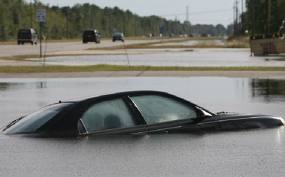
Buying a flood damaged car will usually end badly for the new owner. Flooding causes severe damage to every part of a car. Salt water will especially damage the frame and engine. Mildew and mold problems are common as well. It is advisable to always have a professional and trusted mechanic check out any car you are considering. Here are a few tips for spotting a flood-damaged car.
- Look for dirt, silt and water stains in the glove box, trunk and engine compartment.
- Rust on metal parts such as screws often indicates flood damage.
- Faded, discolored, or water stained door panels, seat belts or upholstery.
- A moldy odor or the overwhelming smell of Lysol which is often used to hide mold and mildew damage.
Ask to see the title, if it says salvage or flooded on it, keep shopping.
A recent decision handed down by the Colorado Appeals court highlighted a case that auto insurers rarely come across, a policyholder who was pursuing compensation for  an incident of road rage that happened outside of their car.
Chanson Roque and Shannon Isenhour brought the case against their insurer after Richard Terlingen injured them. They were beaten with a golf club after an initial argument that took place on the road. According to court testimony, the three parties involved pulled into a McDonald’s parking lot after arguing while driving. Terlingen blocked Roque and Isenhour in, parking his car behind theirs so they could not move. Terlingen then proceeded to assault them with his golf club.
Roque and Isenhour first filed a claim with Terlingen’s insurer in regards to their injuries. After that claim was unsuccessful they sued their own insurer, Allstate for damages under the uninsured motorist section of their policy. Their argument was that since Terlingen’s insurer would not cover their damages, technically he was an uninsured driver.
Allstate, just like Terlingen’s insurer argued that since the incident took place outside of their car, it did not fall under the coverage of their car insurance. This argument convinced the court, which ruled in their favor.
Insurance experts claim that while these cases are rare they seem to pop up every couple of years. While insurers rarely deal with these types of claims, in most cases they tend to end up in the news.
Previous Cases Drove Decision
The last major case in Colorado concerning road rage was decided back in 2003. The case involved a woman suing State Farm after being kidnapped and sexually assaulted in her car. She argued that since the assault happened in her car, she should be able to make a claim on her car insurance.
The court was not swayed and ruled that the car was not directly involved in causing her injuries.
Road rage cases tend to end up in court due to confusion and disagreement over the language used in insurance policies. Road rage tends to be a gray area so these cases sometimes lead to legal action.
One of the bigger legal issues addressed in the Colorado case was whether or not a “causal connection” was created between the injuries and the car when a vehicle was used to block in another car. The court considered a number of cases including the 2003 decision and other rulings dating back to the 1980’s.
The ruling found that using a car to block an escape to commit assault did not create a direct link and it did not justify a pay out on the car insurance coverage.
While an appeal has not been filed, if Roque and Isenhour decide to pursue an appeal it would bring the case up to the Supreme Court. Experts doubt that the Supreme Court would consider the case.
Many states have a hard time dealing with the fact that so many of their drivers are driving while uninsured. A majority of the states have already mandated that drivers have minimum liability insurance coverage but these laws are hard to enforce because most drivers who do not have insurance coverage are not caught until it is too late. Many uninsured drivers have been involved in car accidents so it is important to be proactive.
The state of Alabama mandated twelve years ago that each driver has minimum liability insurance coverage on their vehicle at all times. The issue that they ran into was punishing the offenders. In order for drivers in the state to be able to purchase their vehicle tags, they have to produce valid proof of car insurance coverage. Drivers found a loophole at registration time and they decided to buy an insurance policy and then stop paying for coverage once they had received their tags.
This is something that many drivers have done in the state. They pay one month of car insurance premiums just to get an insurance identification card. It is hard for the state to find these uninsured drivers because their information looks up to date as long as the card has not expired. It is costing car insurance companies a lot of money to have to deal with people who break the law in this way.
Now, state politicians are taking action and on January 1, 2013 a new law will take effect to help to deal with this issue. There will be an online insurance verification system that police officers can utilize to see if a driver has up to date coverage in place. This is a great tool for officers so that they can ticket the offenders.
On a first offense, people can expect to be issued a fine that will not exceed $500. After this offense, every other offense can get drivers a fine of up to $1,000. It does not pay to be uninsured in the state and politicians are hoping that these expensive fines will act as a great deterrent.
Approximately 22 percent of all of the cars that are on the road today in the state do not have any car insurance coverage on them. This means that these drivers pose a risk to others because more than 1 in 5 drivers on the road are breaking the law. If a driver knows that they are uninsured and cause a car accident to occur then they are more likely to flee the scene so that they do not get into legal or financial trouble. Innocent insured drivers could suffer as a result. One form of protection for these drivers is to by uninsured motorist coverage.
Imagine that your child just graduated from college and despite their expensive new degree they are unable to find a job. They move back in with you, and are still driving your cars. They have to be insured so you call your insurance agent with the following question:
Just how long can I keep a child on my car insurance policy?
The bad news is that your child may be unemployed for a while but the good news is that you can keep them on your insurance policy as long as they are living with you. Unlike health insurance, which requires them to get out on their own at age 26, auto insurers will gladly add your 80-year old child to your policy as long as they are under the same roof. The downside of this arrangement is if your child is in an accident or gets a ticket, your rates are going up.
Anyone Living In Your House Has to be on Your Policy
Insurers will not only let you keep your young adult on your policy, they will require it. Insurers must be able to accurately access the risk they are taking and being aware of all drivers in the household lets them properly calculate a premium.
Adding a teen or a young adult to your policy will raise your rates dramatically. Teens and young adults under 25 are expensive to insure because they are inexperienced risk takers who have accidents at four times the rate of adult drivers. In most cases you can expect your rates to at least double and possibly triple.
While it may be tempting to keep your young graduate off your policy it can be an expensive mistake. If your child drives your car and has an accident coverage will be denied and you could personally be on the hook for all damages.
Getting Their Own Car
If your child decides to buy and title their own car most insurers will require that they have their own policy. Having their own policy will be more expensive than staying on yours so if saving money is key you may want keep them on your policy, driving your car.
Once your child has their own car you may want to take them off your policy to drop your rates, however it can be tricky. Many insurers will require you to sign a driver exclusion while they live in your household. An exclusion means that if your child is driving your car for any reason you will not be covered.
Off To College
When junior heads off to college you may think dropping them off your policy will save some money, but many insurers will not allow you to do this. Your child could drive a friends car at college, or drive your vehicles over summer vacation so coverage is still advisable. Insurers usually offer discounts for students who go to college at least 100 miles away and do not have a car.
If your child is at school with one of your cars, keeping them on your policy is usually not a problem. Check with your insurer to verify and determine if there is a rate decrease due to the car being in a different zip code.
Your Kid Has to Go
There are circumstances where your insurer will require your child to get their own policy:
Bad Driving Record – If your child is picked up for drunk driving, reckless driving or acquires a large number of speeding tickets there is a good chance your insurer will insist you move them onto their own policy. You will be required to sign a driver exclusion for your vehicles so your child will be unable to drive them.
Moving Out – Once your child moves out on their own you will need to remove them from your policy. Even if they are driving one of your cars, if they live on their own, have a job and are out of school they will need to get their own policy.
Buy A Car – Once your young adult buys their own vehicle most insurers will require they get their own insurance coverage.
In many cases you can leave your teen or young adult on your policy as long as they are living under your roof. There can be exceptions so be sure to check with your agent on specifics.
Irresponsible spending can negatively affect a person’s credit score and impact the ability to obtain financing, find a place to live or even land a job in the future. One consequence of credit problems that many people are not aware of is the fact that a bad credit score can mean paying significantly more for car insurance.
Why do car insurance companies charge people with a poor credit history more than those with good credit? The New York Times explains that insurance companies utilize the information contained in credit reports and reflected in credit scores to charge higher rates to those with poor credit history because these individuals are viewed as a higher risk. Insurers providing car insurance have noted that people with bad credit tend to file significantly more claims than those with good credit. According to Kiplinger, individuals with a poor credit history may be twice as likely to file an insurance claim as compared to those with good or excellent credit.
Car insurance companies typically use a customer’s FICO score to determine whether a person is insurable and whether a higher premium should be charged. A FICO score is the most commonly used credit score that is calculated based on information found in an individual’s credit report. This three digit number ranges from 300 to 850, and car insurers tend to charge higher premiums to customers with a score lower than 650.
Opponents of the use of credit scores during the process of determining car insurance premiums argue that minorities and people with low incomes tend to be discriminated against when credit information is used. However, car insurance companies that utilize credit information have pointed out that financial data contained in reports cannot indicate whether a person belongs to a minority group and does not contain information about their salary and therefore cannot be considered discriminatory.
Do people with a poor credit score always pay more for car insurance? Not necessarily. While most car insurance companies do take credit history into consideration, polls show that approximately one out of 10 car insurance companies does not use credit reports or scores to determine premiums.
People who already have car insurance coverage may not be affected by credit checks conducted by car insurance companies. Research indicates that credit history is typically only used by car insurers for new customers, and existing customers who are renewing their policy rarely see a raise in premiums due to negative credit information.
Some states allow individuals who receive a higher premium quote due to personal credit information to request a lower premium due to extraordinary circumstances that have had a negative impact on their credit score. Examples of situations that may fall under this category include medical emergencies that have resulted in overwhelming medical bills, job loss coupled with an extended period of unemployment and identity theft. Anyone wishing to claim an exemption due to extraordinary circumstances should research their state laws to determine whether this is an option.
Individuals can obtain a copy of their credit report prior to purchasing a car insurance policy to review the information contained within the report and ensure that it is correct. A free report is available once per year through each of the credit reporting agencies: Experian, Equifax and TransUnion. Even individuals with a poor credit score can find a cheap car insurance policy that fits their budget.
Car theft is something that impacts drivers in all of the 50 states. There are ten cities that have more instances of car thefts than others. The number one worst city for car theft is Fresno, California according to a recent report from the National Insurance Crime Bureau. The city has more than 7,600 car thefts per year.
Many drivers ask are car thefts currently on the rise due to the bad economy? No, actually car thefts are actually dropping; they dropped in 2011 and 2010. The number of car thefts in the United States has decreased by 3.3%. There were more than 700,000 car thefts across the country. The drop in crime could be due to the fact that cars have more advanced computer systems in them so it is harder to steal them.
Most new cars have keys with computer chips in them which mean that only that key will unlock the door and start the ignition.
Some models of cars now come with factory equipped anti-theft devices. If you want to help to reduce the likelihood that your vehicle will wind up being stolen then you should consider looking for a model of car with this feature. Car insurance companies typically offer drivers of these vehicles a discount because they have a safety feature that can reduce car theft.
There are many ways to help protect your vehicle from being stolen. For example, an audible car alarm can be placed in the car. These can cost a hundred dollars or more and they are great because they will make noise when someone tries to get into the car without a key.
One downside to this type of alarm is that it does not instantly alert police to the fact that your car might be being stolen.
Car alarms like this often go ignored because they often sound if someone accidentally hits the car when walking by. It can be a good deterrent though because thieves do not want attention drawn to themselves.
Another great feature is a steering wheel lock. This can prevent thieves from being able to turn the steering wheel even if they have broken into the car. These cost less than $100 and you can find them at auto parts stores and online.
A third feature is a steering column collar. This costs less than $200 and can be installed so that thieves cannot use your steering wheel column to hot wire your car. It is important to have as many safety features on your vehicle because anyone can be a car theft victim. If your car does not have comprehensive coverage then an insurance claim for theft will not be paid out so getting these items can be a lifesaver.
Regardless of weather conditions, parents worry about their kids when they start driving, but winter weather can pose hazards that can increase the likelihood of accidents for inexperienced drivers.
If you live in an area with extreme winter weather, there are measures you can take to keep your teen driver safer on the road. Here are some driving tips to help your young driver better negotiate winter driving conditions:
Practice doesn’t always make perfect drivers, but it does help inexperienced drivers stay safer on the road. Help your teenager practice driving in different types of weather conditions to ensure they know what safety precautions to take. Handling a car in rain, sleet, snow and ice is vastly different than on a dry road, so accompany them in these conditions and help them get the hang of it. Although it might be nerve-racking, it’s better that they have you in the car to instruct them on proper speed, braking and steering in bad weather, so they don’t panic when they encounter it on the road alone.
Enforce the use of seatbelts. While this is true in all weather conditions, it’s especially important in bad weather when the chances of an accident increase. Every year drivers die or are severely injured in car accidents when they could have walked away unscathed had they been wearing their seat belt. Always stress this fact to young drivers. Make sure they insist that their passengers are always belted-up, too.
Knowing how to handle a skidding car is imperative for driving safety in bad weather. Most of us were told to ‘turn in the direction of the skid’ by our driving instructors. Few of us really know what this means and most drivers will automatically turn the wheel in the opposite direction of the skid in the direction we want to car to go. The most important thing when skidding is not to slam on the brakes, as this only makes the skid worse. Lightly tapping on the brake is the best way to slow the car enough to correct the skid. The bottom line is that you must teach your young driver to drive slowly enough and with enough distance from the car in front of them to lessen the chance of skidding when they have to stop in bad weather.
Keep a safety kit in the car for bad weather driving emergencies. It should include a first aid kit, road flares, blankets, non-perishable food and water. If your teen driver breaks down or becomes stranded in inclement weather, these supplies can ensure their survival.
Lastly, set a good example for your young driver by practicing what you preach. Be a safe driver and they’ll be likely to follow your lead and become safe drivers, too.
Most drivers have not read their insurance policy documents in full. It is important to do so because not having the right information could end up costing you money. Each car insurance company has different guidelines for what is covered and what is not when they underwrite their car insurance policies. Even if you have more inclusive coverage such as comprehensive coverage you could still face issues when you go to find an insurance claim.
Each driver needs to make sure that the coverage that they buy has all of the policy features that they will need to limit their financial liabilities if their car is involved in an accident or is impacted by theft, fire, or flood.
One great way to boost your policy’s coverage amounts it to purchased underinsured motorist coverage. This coverage takes effect when the driver who is at fault for the collision does not have enough insurance coverage to pay for your medical bills. The coverage that you buy takes over so that you do not have to pay for your medical bills out of your own pocket.
There is one thing that drivers need to be aware of and that is that you have to have more coverage than the driver’s liability coverage does. If you do not then your medical bills might not get paid for. Some states will allow you to combine the underinsured motorist coverage from additional vehicles that you own. This is what insurance companies call stacking coverage; make sure to contact your insurance company to see if this is possible to do. It is a great safety net to have in place because many people are underinsured due to the bad state of the nation’s economy.
If you use your vehicle for work purposes then you might not be insured. For example, many pizza delivery workers lack the proper insurance coverage that is needed so any claims for accidents or theft could be denied by the insurance company even if the car itself is insured.
Never lend your keys to anyone because theft claims require that forced entry be proven. Just because your car was stolen and you have coverage, it does not mean that the insurance company will automatically pay the claim. They want to see that there was forced entry because fraud often occurs.
Parents need to keep their car keys hidden because many young unlicensed teens have taken the keys without asking and have become involved in car accidents. Unlicensed drivers who are not covered by your car insurance policy and get into accidents will not be covered. Many parents have learned this lesson the hard way when their kids have gone for a joy ride and their insurance claims have been denied. Make sure to know what your policy covers and excludes because it could impact your future.
Employers whose workers drive on work-related errands are often confused about liability issues. For instance, if an employee goes to buy office supplies in his own car and takes a detour afterwards to visit a friend and hits a pedestrian, are you liable for damages? You might be surprised to find out that the answer is yes, you are legally responsible. In another example, if a worker on a non-business-related trip has an accident, you’re not liable, even if they’re driving a company car.
If you’re bewildered about the rationale behind these examples, don’t feel bad – the rules for employee/employer liability are confusing and complicated, whether you operate a company fleet or have a couple of workers who occasionally run company-related errands.
The above examples contain important distinctions, which in legal jargon are known as ‘detours’ and ‘frolics’. In the first example, the employee detoured from the job-related errand, in the second example; he frolicked on a trip that was unrelated to his job, even though he was driving a company car. These distinctions can cost a company significant sums when it comes to paying out accident-related damages.
Muddying the waters even more when it comes to figuring out liability is the fact that states have varying laws on employer/employee driving liability. Some stipulate that if an employee is in an accident in a company car, the employer is responsible, regardless of whether the trip was work-related.
Proper screening of workers driving records is another issue of concern for employers. You might not think it would be necessary if the employee is doing minimal work-related driving, but you’d be wrong. Let’s say that twice a week you require an employee to deliver documents to an office across town. During one of these trips, she has an accident that kills someone and it turns out that she’s had numerous driving offenses of which you were unaware because you never screened her records. Because it’s the employer’s responsibility to conduct background checks to ensure that employees can safely carry out their jobs, you can be held responsible for negligence.
A recent issue of employer liability is distracted driving. In some cases, employers can be held liable for employee accidents caused by cell phone use, if they’ve created a work environment where constant communication is expected of employees. They can also be held responsible if they’ve issued cell phones to employees.
What can you do as an employer to minimize the risk of liability from employee driving? Create a clear policy on safe driving practices – including cell phone use – and have each employee sign it. Also, make sure you check the driving record of any new hire if you think they’re ever going to go on work-related errands.
One issue many drivers face is the fact that they have accrued insurance points. Drivers receive surcharges for insurance related infractions. For example, if you have been involved in a car accident then you will receive insurance points. These points are slightly different than the ones that drivers receive on their driver’s license from the DMV for offenses such as speeding and running a stop sign.
Non moving violations usually do not impact the number of insurance points that you have. For example, if you have a lot of parking tickets then your insurance company will probably not find out about it and penalize your for it. Some states do have guidelines that each insurance company must follow regarding the point systems that they use.
The more points you have, the less likely a car insurance company will want to take you on as a policy holder.
They are also used when insurance agents determine how much you will pay for your monthly car insurance premiums. This means that it is very important to have as few insurance points as possible to have an affordable premium rate.
For example, a driver who has two DUI offenses will most likely either be denied car insurance or will face very expensive premium rates. Each car insurance company assigns insurance points for offenses and traffic tickets differently. This makes it very important for drivers to know how many points each offense would net them.
If you have a lot of insurance points then you may want to shop around for car insurance coverage from another company. You can request insurance quotes online so that you can try to find an insurer with lower rates. Be careful though because the quote might not be as accurate with the insurance point situation not being known to them at the time.
In one situation, a driver may have gotten points for two speeding tickets.
At one car insurance company, he might pay hundreds of dollars more for insurance coverage than at another company. It pays to seek out the insurance point schedules at different car insurance companies before you purchase your policy.
You can find out how many insurance points you have by calling your car insurer. It is a good idea to do this before renewing your insurance policy.
In today’s day and age, car insurance companies can easily find out when you have gotten a traffic ticket so do not think that these issues could be overlooked. Most drivers who receive more than one traffic ticket before their renewal period comes up will see an increase in their insurance premium rates. It is important to be proactive because having this information can help you maintain affordable car insurance premium rates.
The economy in the United States leaves a lot to be desired for many drivers right now. Many men and women live paycheck to paycheck which means that they need to  minimize their car related expenses. One problem many drivers face is the rising cost of gas. Most states charge more than $3.00 per gallon for gasoline. With drivers needing to drive to get to work and run errands, there is a lot of pain at the pump right now.
The state with the drivers that are having the most trouble paying their gas and car insurance expenses is Mississippi.
This is a state that is in the south so many people live in rural areas so they will most often not use forms of public transportation and will have to travel more miles to get to where they are going. A new report has found that drivers there will pay approximately $4,300 for their gas and car insurance bills.
Household incomes in the state are low also which means that many drivers will decide to take the risk and drive while uninsured. When a driver pays more than eleven percent of their household income on gas and insurance alone it can become a burden. The state should consider creating a program to help drivers stay insured. The median income for drivers is under $37,000 so creating an assistance program could help thousands of drivers.
Other states are finding themselves in a similar predicament. In the state of Oklahoma, drivers on average will pay $4,816 for gas and insurance. This is approximately 10.7 percent of a driver’s household income. Most households in the state make around $45,000 per year so they are slightly ahead of Mississippi when it comes to the overall household income and the percentage of income that goes towards these expenses.
Louisiana is ranked number three with expenses averaging $4.504.
Drivers on average will pay 10.5% of their household incomes for gas and insurance coverage and the average household income is currently $42,813. It is very important for drivers in these three states to try to find themselves affordable car insurance coverage. Gas prices are typically high across the board right now so finding cheap gas is almost impossible.
Buying a fuel efficient car that has great crash test ratings can help reduce fuel and insurance costs at the same time. Driving less will not only save you gas but, it will also reduce you insurance premiums according to MoneyCrasher.com.
It is a good idea for drivers to sit down with a car insurance agent and ask for assistance with finding a cheap insurance plan based on your household income. Insurance agents should be able to steer you in the right direction so that you can create an insurance policy that has all of the features that will give you value for your money in these tough times. For a list of potential ways to save on your insurance click here.
Almost half of all marriages in the United States today will end in the couples splitting up and getting divorced. One unforeseen complication for many divorcing couples  has to do with their car insurance coverage.
Many people who are married to each other own their vehicles together jointly. When a divorce happens, it can be hard to divide ownership of the vehicles especially if they are being financed by a bank or other financial lending institution.
It is the responsibility of all divorcing couples to contact their car insurance companies when their divorce has become finalized. If a driver leaves the household and moves to another location then the insurance company needs to be aware of this as well.
This is due to the fact that a change in zip code can impact the insurance premium rates that the driver will have. In most cases, once a couple decides to end their marriage, at least one of the spouses will leave the family home and live somewhere else.
This person could end up moving to a safer or more dangerous area.
Insurance companies need to know about this change immediately because it will change the overall amount of risk that the drivers bring to the table.
If you will be getting divorced then you need to understand a few things. The first is that you and your spouse need to decide on how you will divide up the vehicles that you have. Each driver should make sure that their other spouse will not be personally or financially responsible for each other’s vehicle and car insurance coverage.
Getting divorced will most likely make drivers have to pay more for their coverage. This is because most couples receive multi car and other car insurance discounts. Once the marriage is dissolved, these discounts are no longer able to be used so the premium rate will be adjusted. It is a good idea for people who are getting divorced to consider waiting to take any action until their car insurance policy is near the end of its term.
Car insurance policies come up for renewal once every six months so it can be better to wait to begin to file the paperwork and move out of the home until it is near its end. Contact your car insurance agent because they will be able to help you with this process. Each driver will need to have their own individual car insurance policies so it is important to contact an agent for assistance.
An insurance agent will help you try to find new discounts that you may qualify for such as the good driver and low mileage discounts. This can be a great way to get cheap car insurance coverage after a divorce.
Car insurance premiums in Florida could drop by 14 to 24.6 percent thanks to changes in the state’s Personal Injury Protection regulations a recent report predicted.  Unfortunately, insurers cautioned consumers that other costs could offset those savings and state regulators warned that overall rates may not decline at all.
The intent of the new law is to reduce insurance fraud which is a large problem in the Sunshine State. The statute allows a penalty if a false application is discovered.
Skeptics Abound
Skeptics doubt the effect it will have on fraud and are almost certain that consumers will not see any rate reductions despite the big cuts in benefits that the law puts into place.
The law was one of Governor Rick Scott’s top priorities. Under the new legislation car insurance companies are supposed to reduce PIP rates by 10 percent no later than October 1st and 25 percent by 2014. If they fail to meet these requirements they must offer regulators a valid reason why. According to the new law, insurers have a right to petition for exclusion from the rate reduction which makes rate drops unlikely.
A report released by Pinnacle Actuarial Resources Inc. calculated premium drops in the range of 12 to 20 percent. The State Office of Insurance Regulation threw a big bucket of cold water on the predicted savings when it released a statement warning that other factors might offset those savings. According to the statement, “This projected savings may actually mitigate premium increases, not reduce premiums.” Put another way, insurance bills are not likely to decrease, they might simply increase a little less than they normally would.
PIP coverage is about 20 percent of the overall insurance cost for most consumers so if the full reduction of 25 percent went into affect it would drop most consumers’ insurance bill by about 5 percent.
Insurers are Already Warning Premium Drops Might Not Happen
Insurers are already hedging on premium drops. An industry group urged consumers to have caution and patience with rates. Other industry groups question the conclusions of the study and warned that the study did not calculate the cost of legal challenges to the new PIP law by plaintiffs and their attorneys. Insurers are also warning that various, as of now unnamed expenses could erase those savings for policyholders.
Consumer insurance advocates warn that the new law drastically cuts benefits while offering no guarantee that rates will drop. Critics claim that the mandatory $10,000 PIP coverage forces Florida residents to effectively pay twice for medical coverage, once through their health insurance and again via the required PIP coverage. The law eliminates benefits such as acupuncture and massage and puts a cap on non-emergency care at $2500. The law also requires that a Finding of Emergency Medical Condition must be made within 14 days of the accident and if not filed in time, total benefits are restricted to $2500.
While there are plenty of critics Jeff Atwater, Florida’s Chief Financial Officer believes that the law will eventually help consumers. In a recent statement he said, “Through reforms passed last legislative session, we were able to target the fraud in Florida’s auto insurance system that has caused rates to skyrocket for Florida drivers. The independent analysis released today reflects my firm belief that getting at the root of the fraud in our personal injury protection system will give Florida’s consumers the rate relief they deserve.”
Many first time car insurance buyers are confused when they go to buy car insurance coverage. It is important for these individuals to have some basic advice so that they can make wise insurance purchasing decisions. It is a good idea for younger drivers to have been covered by their parents car insurance coverage before they try to get their own insurance policies. This is due to the fact that many insurance companies want to see proof of previous coverage even if a person was added to another driver’s policy.
You can contact your old car insurance company and ask them to print out a claims history for you which you can send along to your new insurance company. This can reduce your car insurance rates and help you get a lower deductible. If you filed any claims while on someone else’s plan then you may not want to divulge this information unless you have been asked about your previous coverage.
One great option to reduce your rates even before you get a quote is to take a defensive driver’s education course. These can be done entirely online and they allow new drivers and those who have never had their own car insurance policies to save money.
When looking for an insurance policy, have a budget set already. Write down a list of every expense and even budget for emergencies. It is never a good idea to allow your insurance coverage to lapse because your premium rates will be high for a long time.
Next, decide which type of policy is right for your car based on its age, value, model, and whether or not it has been financed. For example, if your car is new then getting collision and comprehensive insurance coverage is a good idea because it is all inclusive. For example, if the car is stolen, flooded, catches on fire, or is totaled in an accident then the insurance claim will be processed with liability insurance no compensation would be given out.
If you have a small budget and cannot afford collision or comprehensive coverage then consider increasing your minimum liability coverage amounts. This can help to protect inexperienced drivers who might be at fault for a car accident and then wind up getting sued. It is much better to have more coverage than not enough especially when inexperienced drivers are usually those with limited financial means.
It is a good idea for first time buyers to ask an insurance agent which policy options would be best for their budget and needs. Some younger drivers will qualify for discounts which can help to reduce the overall costs. It is important for all first time buyers to take their time when shopping so that they can get a good deal.
The Tennessee Supreme court recently ruled that the emotional distress of Jerry and Martha Garrison following the death of their son Michael was not covered under the uninsured motorist part of their State Farm bodily injury coverage.
The Supreme Court upheld the District Court of Appeals ruling which declared that Tennessee’s mandatory bodily injury coverage was never intended to cover emotional distress due to an accident.
Son Killed in 2006
Michael Garrison was killed in 2006 when he was struck by a car being driven by Andy Bickford. Garrison was riding a mini bike close to his home when he was hit. Jerry and Martha, Michaels parents arrived on the scene shortly after the accident and stood by helplessly as they waited over an hour for the ambulance to arrive.
According to court testimony, Michael was barely breathing and bleeding heavily at the accident scene. His mother Martha was “emotionally overcome” while waiting for help to arrive. Michael later died at a local Chattanooga hospital due to his severe injuries.
The Lawsuit Hinged on Definition of ‘Bodily Harm’
The Garrisons filed a wrongful death lawsuit after the death of their son. They sued both Andy Bickford, the driver of the car as well as his mother Rita Bickford who owned the car, both of whom were uninsured. The Garrisons claimed they “suffered grief, fright, shock, depression, loss of sleep, and other problems,” due to the accident and loss of their son. This lawsuit was eventually settled when the Bickfords agreed to pay a wrongful death claim of $25,000 and an additional $25,000 for emotional distress.
The Garrisons filed a claim with their insurer State Farm under their policy’s uninsured motorist (UM) coverage. Their policy had a $100,000 per person limit and a $300,000 limit per accident. The UM section of the policy offered coverage for “damages for bodily injury an insured is legally entitled to collect from the owner or driver of an uninsured motor vehicle.”
In their claim with State Farm, the Garrison’s stated that they “suffered grief, fright, shock, depression, loss of sleep and other problems” due to the crash and witnessing the injuries prior to their son’s death. State Farm settled the claim for $75,000 but refused to pay out on emotional distress, claiming that the bodily injury section of their uninsured motorist policy does not cover emotional distress.
The Garrisons decided to pursue the case in court. According to Tennessee law all car insurance liability policies must contain uninsured driver coverage which lets accident victims “recover compensatory damages from owners and operators of uninsured motor vehicles because of bodily injury, sickness or disease, including death, resulting from injury, sickness or disease.”
The Garrisons argued that if Tennessee law meant to exclude mental and emotional injuries from bodily injury coverage they would have excluded the “sickness and disease” wording. They argued that the wording could cover a wide range of medical conditions.
The Tennessee Supreme Court disagreed with their argument. They found that the issue had been litigated in numerous state courts and that the language of the Tennessee state law and State Farm’s policy was very clear. They dismissed the references to “sickness and disease” and ruled that the intent of the coverage was only for conditions that arose from bodily injuries.
The court was clear in its opinion, “We conclude that in the context of purely emotional injuries, the phrase ‘bodily injury,’ as defined in the policy before us, is unambiguous. Its ordinary meaning connotes a physical injury. Thus, we hold that, as applied to this case, ‘bodily injury’ in the policy does not include damages for emotional harm alone.”
If you are hoping to save money on your car insurance, don’t move to Michigan. The 26th state has the most expensive insurance rates in the nation according to a recent survey. Michigan drivers pay the highest percentage of their income towards auto insurance in the country, a whopping 8 percent. Here is a quick rundown of the most and least expensive states to insure your car.
Michigan – Car insurance rates in Michigan average $2541 which puts them on the top of the heap for high car insurance rates. Michigan law requires that every policy provide unlimited personal injury protection. This means that if you are in an accident and severely injured, your insurer will have to pay for physical therapy for the rest of your life. The high cost of insurance has lead to an uninsured driver rate of almost 19 percent according to the Insurance Research Council.
Louisiana – Drivers in Louisiana fork up five percent of their income for car insurance. The average premium runs around $2453. State judges preside over accident claims under $50,000 and high awards help keep premiums high. Despite a no-pay, no-play law which limits damage awards to uninsured drivers, the uninsured rate is still 13 percent.
Kentucky – This state rounds out the top three most expensive states to insure a car. Kentuckians spend roughly 4.5 percent of their annual income on car insurance. The average premium comes in at $2,292.
The rest of the top ten are as follows:
4. West Virginia: 4.3 percent
5. Mississippi: 4 percent
6. Arkansas: 3.7 percent
7. Delaware: 3.6 percent
8. New York: 3.5 percent
9. Nevada: 3.4 percent
10. Florida: 3.3 percent
The Least Expensive States to Insure a Car
If you are looking for low car insurance rates these states can help you save a ton on your yearly premiums.
Massachusetts – Moving to Massachusetts can be a money saver, the residents of this state devote only 1.4 percent of their income to car insurance. The results may be slightly skewed due to the high median income in Massachusetts.
North Carolina – This state comes in as the second least expensive state in the nation and is much more representative of the national median income. A court system that frowns on auto accident claims and a mostly rural population accounts for the low rates. Residents here pay a tiny 1.6 percent of their income towards car insurance.
Hawaii – The median income in this state runs about $76,000, which means that residents of Hawaii are only paying about 1.6 percent of their income towards insuring their cars. The average price Aloha State drivers are paying is $1244.
These states round out the top 10 least expensive states to insure your car:
4. Alaska: 1.7 percent
5. Oregon: 1.95 percent
6. Iowa: 1.97 percent
7. New Hampshire: 1.98 percent
8. California: 1.991 percent
9. Virginia: 1.992 percent
10. Maine: 1.993 percent
State regulations have a big impact on insurance rates. Michigan is so expensive because they require policies to guarantee unlimited personal injury coverage. In addition to state regulations, factors such as the cost of medical care, the amount of fraud and the percentage of uninsured drivers will affect insurance rates. Population and the likelihood of residents to sue can also push rates higher or lower.
No matter what state you live in shopping your insurance rates every couple of years is the best way to make sure you are paying the lowest possible premium. Ask for all available discounts and considering bundling your home and auto to get the best deal.
Being a parent can be a thankless job. With the economy being in a bad way, many teens are unable to get jobs. This means that often parents are the ones to buy their kids their first cars so that they can try to use the car to be able to get to job interviews. According to a new poll, more than 33% of teen drivers get their parents to buy them their first vehicles. A few decades ago, only ten percent of teens got their first cars paid for by their parents.
Some parents decide to take this step because they want to make sure that their teen drivers are getting safe cars that are reliable.
Many teens do not thoroughly research vehicles that they want to buy. This can lead them to look on a car’s aesthetics such as color, make, and model without them taking into account mileage, crash test ratings, and other issues.
Twenty percent of teens also have their car insurance premium payments paid for by their parents as well. It is important for parents to be able to not only buy their kids reliable cars but also to produce responsible drivers.
Many teens that rely on their parents a great deal for financial matters do not always follow the rules of the road. They often get involved in car accidents and believe that their parents will always be there to bail them out of trouble.
Parents should consider having their kids help to pay for the vehicle that they want to get. This can help to instill responsible traits in them. Driving is no laughing matter and every year thousands of teen drivers are killed while they are behind the wheel of a vehicle. This generation is one in which most teens think they are bullet proof but sadly that is not the case.
One woman bought her son a brand new convertible for his sweet sixteen. He died the same night after he and a friend went joy riding and slammed head on into a guard rail.
One way parents can do this is by mandating that teens sign a document outlining how they will behave when they are behind the wheel of a car. It is important for parents to keep apprised of how their child drives because many teens are secretive and feel that their parents are invading their privacy when they ask them questions.
Another idea is for parents to consider having a family member or close friend drive with the child when they are not going to be around. This allows a neutral third party to observe the teen while not having any tension in the car. Times have changed but unfortunately car accident scenarios have stayed the same.
Renting and leasing vehicles are common practice by individuals nowadays, lease a nicer car to save on car payments, and be able to put les money down. Renting a car is  done by millions of people every day for one reason or another. The important thing is to know you have adequate insurance coverage or you are not wasting money by purchasing redundant, duplicate coverage, and know what the bottom line costs will be.
Leasing deals are attractive, you can have a $40,000 car for the payment of a $20,000 car, but of course you don’t own it. Leasing a vehicle over buying it outright can come with certain insurance requirements, well as different registration procedures. When you lease a car you don’t own it, the leasing company is the owner, of course at the end of the lease you have the option to buy, but in this scenario the car still belongs to the lessor. Since it is still their car and in the majority of cases will be returned to them, they want to protect their interest. When registering a leased vehicle the care is registered to the leasing interest. If you plan on keeping your 30 year old license plate, you can’t, new owner requires a new plate. Excise tax is also important. The contract will stipulate who is responsible for excise tax, your or the leasing company, normally under a standard car loan, or if you own the car outright you are always responsible for excise tax. Remember, expensive vehicle, expensive excise tax. Insurance will be different as well; again you don’t really own the car, so they are protecting their vehicle. Since they want the automobile returned in re-saleable condition, they want adequate insurance to protect it. You may be required to carry lower physical damage deductibles, since the lessor will want to make sure their vehicle is repaired in an accident. They also may make you carry higher liability limits, again, protecting their interests. Since the car is new, maybe more costly, you are required to carry higher limits and lower deductibles, your new insurance premium may skyrocket. Don’t forget to take care of your leased vehicle, when the lease is up you are responsible for anything beyond normal wear and tear.
When you rent a vehicle it may be short term, but it also comes with its own costs and liabilities. If you don’t have your own insurance the renting company will make you purchase insurance, they are of course protecting their vehicle and their liability. If you do have you own insurance the renting company may try to sell you added coverage that may not be necessary, you may be covered by your own policy or even your credit card may provide supplemental damage coverage. Check the terms with your credit card company, and review your insurance policy or contact your agent.
Go into any leasing or rental deal prepared. Know what you need for coverage and have an idea of what all the final costs will be. What looks like a money saving deal may add up in the long run.
While traveling the nation’s roads everyone has seen or been subject to the over aggressive driver, the highway trouble-maker. The culprit is tailgating you, passing on your right, cutting in front of you with no time, or not time and no signal, the list of infractions goes on and on. How can the careful courteous driver avoid the road menace? Other than not driving at all, which of course is not practical in this day and age, there are ways to stay safe when on the roads with the dangerous.
One of the biggest problems that appear to be a recent phenomenon is road rage. You yourself may have accidentally annoyed an aggressive driver by cutting in front of them and now they are angry, honking, tailgating, and driving erratically. The important thing is to not engage the other driver. Get out of their lane, reduce speed and stay far behind the aggressor, any moves of retaliation or aggressiveness on your part will infuriate the agitator more and escalate the situation.
You yourself have to avoid being the aggressor. Don’t be a distracted driver, don’t drive while texting or fooling with your phone, you may agitate another driver not to mention cause an accident yourself. Use your signals when turning, with plenty of time before a turn. When driving on the highway, merge appropriately, don’t try to race the car that is already on the highway at speed. Once you settle into the flow of traffic, stay in the middle lane at the speed limit, and only go into the passing lane to pass slower vehicles. When in the passing lane, use the time wisely to only accelerate enough to pass the slower car and move back into the middle lane, if someone wants to go faster than you in the passing lane they will become irritated and stat to tailgate you. Don’t tailgate yourself. While on the highway or on any other road, leave plenty of room between you and the car in front of you. If you rear-end another vehicle most of the time the accident is considered your fault. Obey the traffic laws, even if you feel the “No Turn On Red” sign is pointless, it’s there for a reason, the oncoming traffic in the other lane may be coming at a higher rate of speed, or there may not be a clear line of sight for the traffic to see your car turning into their lane with enough time. This goes for full on stop signs as well. Don’t approach a stop sign while rolling, fully stop count to three, and then proceed if able. Another sign taken lightly appears to be the yield sign. If you are at an intersection or highway with a yield sign, gauge the situation cautiously; try to determine the adequate time and speed needed to merge without disrupting oncoming traffic. When a traffic sign isn’t obeyed properly, and an accident occurs, it would most likely be your liability.
A simple thing to remember is this, act like you are invisible to other vehicles. Even though you think that car already on the highway sees you merging, they may be distracted and not be paying attention to you, thus you are invisible. This could apply to changing lanes as well; even though you think there is ample room and time to get in the next lane, the other car again may be distracted or not paying attention to your vehicle, invisible again. Try to be cautious and courteous when driving, and will protect your life and save you money on insurance.
Many small businesses in the fast food industry employ young people to be their delivery drivers. One thing many of these young employees do not understand is that in many cases, they are not covered by any car insurance coverage when they work at their jobs.
Most car insurance companies require that these employees purchase commercial driving insurance coverage. This can be expensive to buy so many employees choose not to purchase it.
Many delivery drivers know that what they are doing is wrong but in today’s economy they know that finding another job is very hard so they say nothing. Many employers are trying to cut corners to save money so they look the other way as well. This works only until someone gets into a car accident. Many delivery workers travel fast when they are behind the wheel because they want to deliver the food quickly and make as much money in tips as they can.
Even though these workers own their own vehicles, they typically are not covered by any insurance. If an employee gets into an accident while delivering food then their car insurance company does not have to pay out any benefits for the insurance claims. This has left some delivery workers in hot water financially.
Most drivers who want to get commercial driving insurance will see their premium rates increase by approximately 50 percent. It is a good idea for young people to find restaurants that supply their drivers with a vehicle that is insured. This can be a financial lifesaver for them. Sometimes employers will decide to compensate their drivers for gas and mileage and then pay half of their insurance premiums. It really depends on the size of the business and what value they place on their employees.
If delivery workers have to pay out of pocket for their gas and insurance then their incomes will be very small. This can lead to a high turnover rate which is bad for small businesses. It is crucial for young people who want to be delivery workers to discuss the financial responsibilities of the insurance. This will allow them to know up front what expenses they will have so that they can decide on whether or not they want to take the job.
In today’s economy, young drivers should make sure to have not only the basic insurance coverage but additional coverage as well if they will be using their car at work or to get to work. A car is a financial investment and if a teen driver relies solely on it to get to work then having additional coverage such as collision or comprehensive because it can be a valuable asset if the car gets damaged or totaled.
Most drivers think that just having the minimal coverage on their vehicles will allow them to follow the law and sleep at night. However, having some extra coverage on your vehicle does not have to break the bank and can be a lifesaver if you are involved in a car accident.
The first extra is comprehensive coverage. This is mandated on financed vehicles because it covers damage from fires, thefts, floods, and allows the car to be replaced if it is totaled. If your car is not an old clunker then it is an investment opportunity. Liability coverage only on a car makes it vulnerable.
For example, if a young woman is traveling across country and parks her car in a bad neighborhood and goes to eat and her car is stolen then this coverage would cover her losses. This would allow her to be able to file an insurance claim and collect a compensation check so that she can buy a new car.
A woman who had the same thing happen to her but had minimum liability coverage only would have to find a way home because she would not be able to file an insurance claim for her losses. The coverage may seem expensive but the added expense helps to offset any costs that might arise from making a claim.
The second added feature to consider buying is uninsured/underinsures motorist coverage. This adds less than a few hundred dollars to the price of a car insurance policy and can be a big help.
For example, if an uninsured person was at fault for a car accident where you were injured then your coverage would pick up the tab for the medical and repair costs that were incurred.
Without this coverage, many drivers would be left out in the cold financially. Most drivers would have to spend months or even years in a court room filing a lawsuit against the uninsured at fault driver to get the compensation that they need. It is good to have because the number of uninsured drivers is very high in all of the 50 states.
The third and final extra feature to consider adding is collision coverage. Being involved in a collision is not only scary but it can total a car.
Even if your car is not financed, you should consider getting this type of coverage because it allows drivers to collect compensation if their car is damaged or totaled during an accident.
Cars can be expensive to replace and many families need a car every day to get around so the coverage can help protect the family’s financial investment. In today’s economy, it is a good idea to safeguard your financial investments including vehicles just in case of an accident.
The mere mention of Proposition 33 evokes emotions from many drivers. This new proposition has had a lot of support from a man named George Joseph who is an insurance executive. The way that the proposition works is that anyone who has allowed their car insurance policy to lapse for a period of more than 90 days would face a surcharge.
This would hurt many residents in the state of California financially. Currently, the unemployment rate in the state is high due to poor economic conditions and the fact that the state is facing a massive deficit. Some drivers take public transportation to get around if they do not have a long commute so they might have allowed their car insurance coverage to lapse. Others might have been unemployed or could not afford the coverage so they might have had a lapse as well.
For example, if a college student who went to school did not need to use his car during the school year then he might park his car at home and leave it uninsured for months at a time.
This college student would end up facing a surcharge and much higher car insurance premium rates which many drivers think is unfair.
Proposition 33 is a ballot initiative and if it is passed then drivers who did not have insurance before or who have never had it in the first place could pay a very high price for coverage. In an election year, passing something like this does not seem like it would benefit the state’s drivers or car insurance companies.
For example, if the state’s drivers have to face surcharges and much higher premium rates because of prior lapses in coverage then they might become discouraged and just stay uninsured. Yes, car insurance companies like the idea of being able to make more money by charging higher premium rates to their policy holders but they also risk alienating them with such initiatives.
The more money that consumers have to pay for their car insurance premiums, the less likely they are to be loyal to any one insurance coverage provider in the state. Money talks so competition would soar if the measure passed. It is important for voters to understand that the ballot initiative could be a major game charger in the state.
More than two decades ago, the state voted down a measure that would have allowed lower income families and others who were not insured to be penalized for having never been insured before. The election will be held in less than two months and at that time the state’s voters need to decide if the proposition will indeed pass. If it does, then drivers across the state could be forced to pay more money for car insurance coverage.
One problem that many cities across the globe face is drivers who run red lights. When a driver runs a red light they can cause an accident to take place. This has prompted Windsor, Ontario to install red light cameras so that they can catch the offenders.
One problem that many drivers have stated is that these cameras do not do very much. They would prefer that automatic number license plate recognition software be used. This is technology that can read a driver’s license plate numbers and track down offenders who have broken the law. Some drivers feel that installing them on police cars would be very helpful at accomplishing this task.
Politicians have stated that investing in this type of technology would cost too much money.
Supporters of the idea have said that cops could use mobile units and go from place to place and be effective at reading license plate numbers. The act alone would help to find drivers who are uninsured, locate people with outstanding warrants, and help to deter criminals from committing crimes such as car theft.
In today’s economy, many police officers are being let go because budgets are stretched too thin. When technology can be used, it should be utilized to help make cities safer. These mobile units can read hundreds of license plates per day which is a huge help to the police force.
When a human being is assigned this task, they can often become distracted or make mistakes when they take down the license plate numbers and check them.
This technology is great because if a person does not have car insurance coverage then an alert will come up so that the driver of the vehicle can be cited for the infraction. It is important to find and ticket uninsured drivers because they pose a hazard to other drivers who are on the road. The units do not need to be manned so they could actually save police departments’ money and manpower hours.
One issue with red light cameras is that some drivers use illegal license plates which make reading the numbers almost impossible. There are also issues with people having illegally tinted windows so that police officers cannot identify their faces or look into their vehicles. It is important for cities like Windsor to be able to use technology so that they can devote more manpower hours to keeping the streets safe.
Many new innovations have been created to help law enforcement officers track down people who are breaking the law. This type of software could help car insurance companies be able to have more policy holders because uninsured drivers would be getting fined often so they would catch up on their premium payments.
It’s illegal to base insurance rates on a consumer’s income, but it appears that low income drivers are at a disadvantage when it comes to getting a deal on auto coverage. A report released by the Consumer Federation of America (CFA) says that people in low to moderate-income brackets are paying considerably more for car insurance than those with higher incomes.
The report reached its conclusion after reviewing insurance pricing among more than 100 insurance companies. The results showed that not only do consumers in lower income brackets pay more for the same amount of auto coverage than people with a higher income; they also pay more for significantly less coverage. The study also shows that in metropolitan areas, policies purchased in low income neighborhoods cost anywhere from 8% to 94% more than in affluent neighborhoods in the same metro district. Another aspect of the survey reveals that auto coverage on average costs 40% more for low education consumers who work in less skilled occupations than their more highly educated, highly paid counterparts.
In response to the report, a spokesperson for the Insurance Information Institute stated that even though insurance companies collect information on a consumer’s education, job status, whether they own or rent their home and their place of residence, the primary factors that figure into pricing are their driving record and credit history. They say that the information they collect helps companies accurately gauge the amount of risk, and thus the cost of insuring drivers.
The CFA says that insurance companies aren’t required to divulge how they distribute the information they collect into their pricing structure, so there’s no accurate way for consumers to know why they’re charged the rates they end up paying. The fact is that lower income drivers can end up paying as much as $1,000 more annually for coverage, which adversely affects their ability to make ends meet and creates a financial hardship in areas where people need to drive to get to work.
For now, there’s little that low to moderate income drivers can do to ensure they get the best deal possible on auto insurance except to shop around, keep a clean driving record and maintain a good credit rating.

